Google Ads
Marketing Ops
If your account used to hit targets and now misses CPA/ROAS, this post gives an operator-level triage, short-term fixes you can apply this week, and a tool-based workflow using ExecWrite to recover wasted spend. Run a quick snapshot at ExecWrite to get a reality check on leak points.
- Most short-term PPC declines come from wasted spend, poor search-term coverage, and bid timing mismatches.
- Apply a 7-step account triage this week to stop the biggest leaks before you re-scale bids or budgets.
- Use two fast ExecWrite tools—Wastage Snapshot and Search Term Analyzer—to find recoverable spend and exact bid actions.
Table of Contents
Why PPC feels harder now
Algorithms changed, competition rose, and measurement got noisier. That combination exposes operational gaps: stale negatives, misaligned landing copy, and bidding that ignores time-of-day or search-term nuance. The good news: these are operational problems you can fix without overhauling strategy.
The 5 biggest PPC problems marketers face
1) Wasted spend on low-intent queries
Symptoms
- High click volume with no conversions in mid-to-low funnel keywords.
- Large % of budget in campaigns with conversion rates < account average.
- Search terms report shows irrelevant modifiers or discovery queries.
Why it happens
Broad match and automated bidding amplify irrelevant queries if negatives and keyword structure are weak—especially after a period where bidding was scaled up.
Fix this week
- Export top 1,000 search terms by spend; tag obvious negatives (free, jobs, careers, sample).
- Add high-cost, zero-conversion queries as negatives at campaign level.
- Pause high-spend ad groups that don’t convert and reallocate budget to proven winners.
2) Bid timing and hour-of-day swings
Symptoms
- Strong performance during a few hours, poor the rest of the day.
- High CPA spikes correlate to specific hours or days of week.
Why it happens
Ad schedules often inherit settings from old tests or a single-date launch and ignore hour-level ROAS/CPA patterns. Automated bidding can’t always compensate for rigid schedules.
Fix this week
- Run an hourly performance pivot (cost, convs, CPA) for past 30 days.
- Set ad schedule modifiers: throttle down during low-performance hours, lift during peaks.
- Test small bid multipliers by hour for 7–14 days and monitor delta.
3) Ad/landing page mismatch (Quality Score and conversion drops)
Symptoms
- CTR falling while CPCs rise; landing pages have high bounce rates.
- Ad groups with broad keywords and generic headlines underperforming.
Why it happens
Creative and landing pages drift apart from keywords over time—promotions change, and copy gets stale. Quality Score and conversion rate suffer when users don’t see continuity from search to ad to page.
Fix this week
- Audit top 20 ad groups for headline-to-landing relevance; update headlines to match highest-intent keywords.
- Use a quick landing-page A/B: headline + CTA alignment for the highest-spend ad groups.
- Add relevant sitelinks and structured snippets for trust signals.
4) Budget leaks & neglected campaign priorities
Symptoms
- Traffic that doesn’t match attribution windows or business priorities.
- Lower-funnel campaigns underfunded while broad-reach campaigns spend out.
Why it happens
Campaign priorities are often set once and forgotten. Automated budget allocation follows spend velocity, not strategic outcomes.
Fix this week
- Review budget pacing and move budget to campaigns with proven CPL/CPA.
- Limit daily budgets on broad campaigns and schedule mid-day checks for overspend.
- Layer negative lists down to the campaign level to protect core audiences.
5) Keyword structure and ad group bloat
Symptoms
- Ad groups with dozens or hundreds of keywords and mixed intent.
- Low CTR and low Quality Score across many ad groups.
Why it happens
Teams keep adding keywords to existing ad groups instead of creating intent-aligned ad groups or SKAGs for high-value terms. That dilutes relevance and bidding efficiency.
Fix this week
- Identify top 50 keywords by spend and separate into tight ad groups (1–3 keywords each).
- Pause low-volume keywords and re-import winners into structured campaigns via CSV.
- Apply distinct landing pages per ad group where possible for better relevance.
Fixes you can apply this week
- Run a quick wasted-spend snapshot and triage the top 5 leak drivers.
- Export and action top 1,000 search terms: negatives, move winners, pause losers.
- Set hour-of-day bid modifiers for obvious peaks and troughs.
- Re-align top 20 ad headlines to landing page intent; run a CTA split test.
- Reallocate budget toward campaigns hitting target CPL/CPA and cap broad-reach spend.
Run a free Wastage Snapshot and get a prioritized recovery plan in minutes.
Tool-based workflow (map pain points to ExecWrite tools)
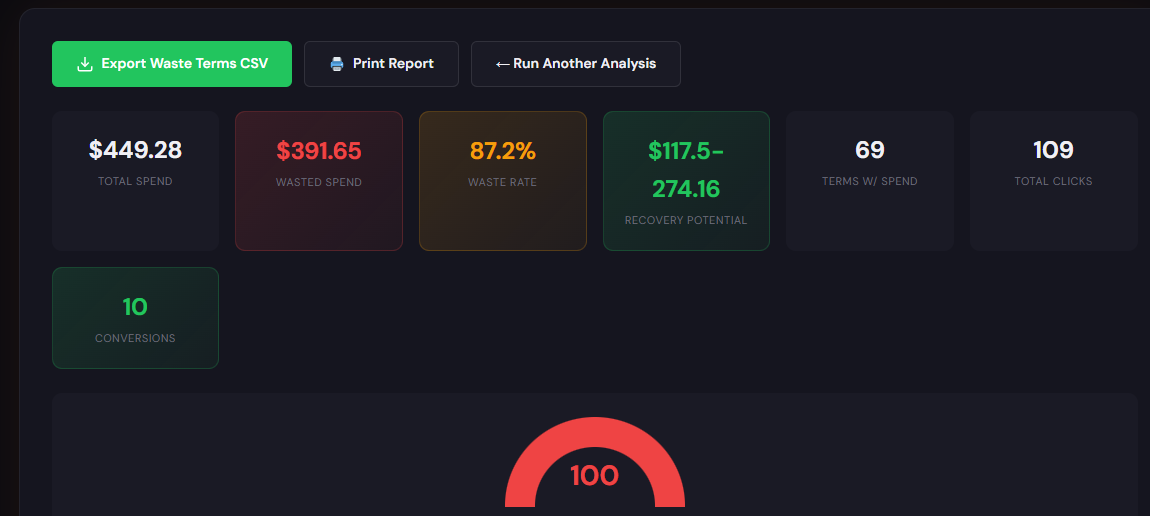 What it outputs: a dashboard-style snapshot showing total wasted spend, top leakage areas (search terms, campaigns, devices), and a recovery plan with immediate actions.
How to use it (3 steps):
- Upload or connect a 30–90 day account export.
- Review the top 5 leakage areas the snapshot identifies (negatives, budgets, low-converting campaigns).
- Export the recovery plan and apply quick wins: negative list, pause rules, and budget moves.
Use it for: wasted spend audits, negative keyword discovery, budget leak triage. Open Wastage Snapshot
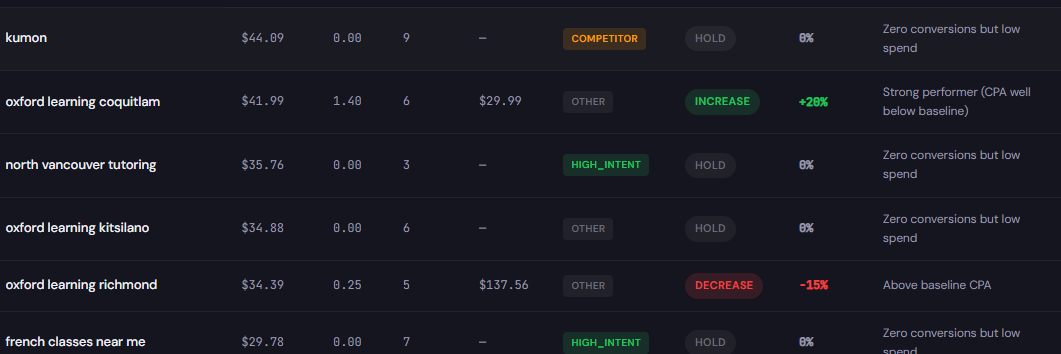 What it outputs: an exportable table with spend, conversions, CPA/ROAS by exact search term and recommended bid actions (pause, lower, keep, raise).
How to use it (3 steps):
- Load your recent search-terms export into the tool.
- Review tags and the recommended bid action column—prioritize terms flagged as “raise” or “pause”.
- Push changes via Google Ads Editor CSV or apply suggested negative lists and bid adjustments directly.
Use it for: cleaning broad-match leakage, identifying negatives, and making exact bid adjustments. Open Search Term Analyzer
90-minute account triage playbook
A focused, time-boxed triage to stop the bleeding and capture quick wins.
- 0–10 min: Pull last 30 days of account data (search terms, campaign performance, hour-of-day).
- 10–25 min: Run the Wastage Snapshot to get top leakage categories.
- 25–45 min: Export top 1,000 search terms and run Search Term Analyzer for bid actions.
- 45–60 min: Apply immediate negatives and pause top 3 cost-without-conversion ad groups.
- 60–80 min: Set ad schedule modifiers—reduce bids during worst-performing hours, raise during peaks.
- 80–90 min: Reallocate daily budgets: move 15–30% to campaigns with CPA below target and set monitoring alerts.
Use the two tools above to complete the 90-minute triage and export action-ready files.
FAQ
You should see reduced wasted spend within 24–72 hours for negatives and budget caps; bid adjustments and ad/landing changes often show results within a week.
Pausing low-performing, high-cost keywords prevents waste. Reintroduce tightly structured, intent-aligned keywords later as separate ad groups to test performance.
Automated systems are useful, but they need clean inputs. Use ExecWrite tools to produce clean action lists and then apply changes in controlled batches.
Start with negatives, budget caps, and pausing top cost-without-conversion ad groups—these yield the fastest ROI on time invested.
Leave a Reply