You don’t need a month-long audit to find obvious leaks. This article shows the pragmatic fixes that recover budget and stabilize performance in days — and how to run fast checks with tools from ExecWrite.
- Most wasted spend comes from bad search-term fit, hour-of-day swings, and weak ad-to-landing relevance.
- Run two focused tools (wastage snapshot + search-term analyzer) to find quick negatives and bid fixes.
- Use the 90-minute triage to recover budget and set a 7-day test plan with concrete actions.
Table of Contents
Why PPC feels harder now
Bids and automation got smarter, but account-level hygiene didn’t. Marketers are left defending spend against algorithmic shifts, noisy queries, and poor cross-account signal. The result: more budget evaporates into low-intent clicks and inconsistent hour/day performance.
The 5 biggest PPC problems marketers face
1. Wasted spend from irrelevant search terms
- Symptoms: High clicks, low conversions; many single-click non-converting terms; impression spikes with no pipeline.
Why it happens: Broad-match and loosely structured ad groups pull unrelated queries; negative lists aren’t updated; match-type drift over time.
- Export last 30 days of search terms sorted by cost and clicks.
- Pause or add negatives for top 20 terms with zero conversions but high cost.
- Create tight, single-intent ad groups for high-cost queries and test exact phrase match.
2. Hour-of-day and dayparting swings
- Symptoms: CPA or ROAS varies dramatically by hour; campaigns overspend during low-conversion windows.
Why it happens: Performance cycles (time-of-day buying behavior) and automated bid strategies learning on stale or mixed signals create misaligned bids.
- Pull hour-by-hour conversion/CPA data for top campaigns.
- Set ad schedule modifiers: cut bids in low-performing hours, increase where ROI is stable.
- Run a short A/B: automated bidding vs. schedule + adjusted bids for 7 days.
3. Low Quality Score and messaging mismatch
- Symptoms: High CPCs, low CTRs, landing page bounce spikes after ad clicks.
Why it happens: Ads and landing pages aren’t aligned to the user intent signaled by keywords; landing pages aren’t optimized for the ad message.
- Match headlines to top-performing search intent groups and update landing pages.
- Test two variants of headline + CTA on the landing page tied to ad copy.
- Move low-QS keywords into a landing-page test bucket rather than pausing immediately.
4. Over-reliance on automation without guardrails
- Symptoms: Sudden spend spikes, large shifts in keyword capture, unexpected bid increases.
Why it happens: Automation optimizes toward conversions in aggregate, but without account-level constraints it can chase low-quality volume.
- Set conservative bid caps and target CPA ranges per campaign.
- Exclude cohorts or hours where automation drove unprofitable volume.
- Use manual overrides for high-spend, low-return keywords until stable.
5. Structural account decay (keywords, audiences, negatives)
- Symptoms: Campaigns that used to hit targets now drift; long tail of unmanaged keywords; overlapping audiences driving higher CPCs.
Why it happens: Accounts are living systems — without a routine maintenance cadence, noise accumulates and performance declines.
- Run a quick structure audit: ad group count, single-keyword ad groups, broad-match controls.
- Consolidate overlapping audiences and harmonize negative lists across accounts.
- Schedule monthly hygiene tasks and assign owners.
Fixes you can apply this week
- Run a wasted-spend snapshot for top 3 accounts to get a prioritized recovery list.
- Export search terms (30 days), tag top-wasters, and add negatives directly.
- Apply simple hour-of-day bid modifiers (-30% or +20%) where CPA swings are >40% vs. daily average.
- Create two landing-page headline variants and route 20% of traffic to each for a 7-day test.
- Set a conservative max CPC or CPA cap on automated strategies for 7 days.
Start with a diagnostic that highlights wasted spend, leak sources, and quick negatives you can apply now.
Tool-based workflow: map pain points to two ExecWrite tools
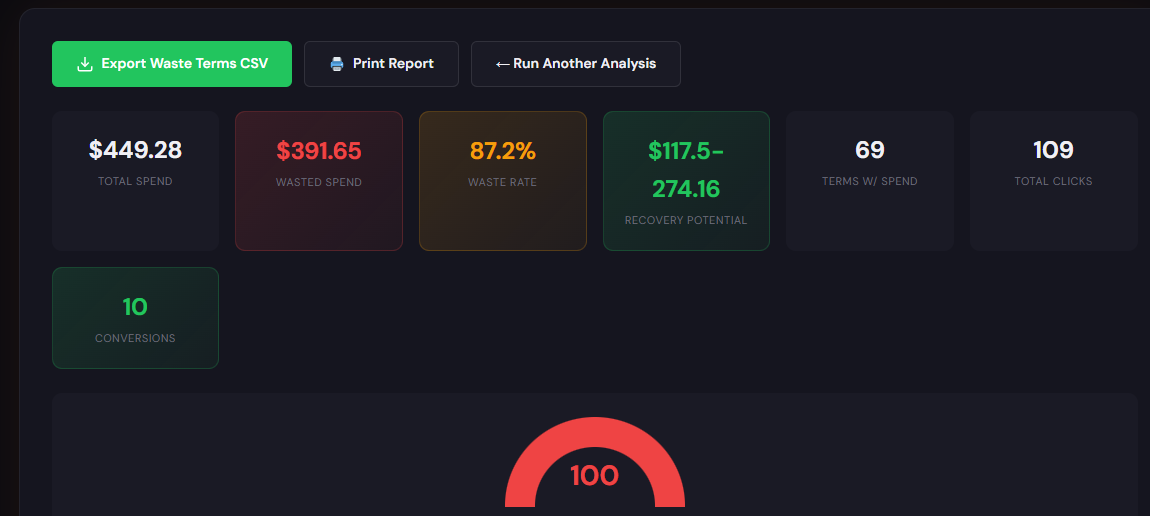
What it outputs: Account-level waste totals, prioritized leakage areas (e.g., high-cost no-convert terms, budget leaks, conversion mismatches), and a short recovery plan.
How to use it — 3 steps
- Upload or connect a 30–90 day performance report to generate the snapshot.
- Review the top 10 leakage items the tool returns: negatives to add, campaigns to pause, landing pages to test.
- Export the recovery plan and apply the top 5 actions in your account today; re-run in 7 days to measure reclaimed budget.
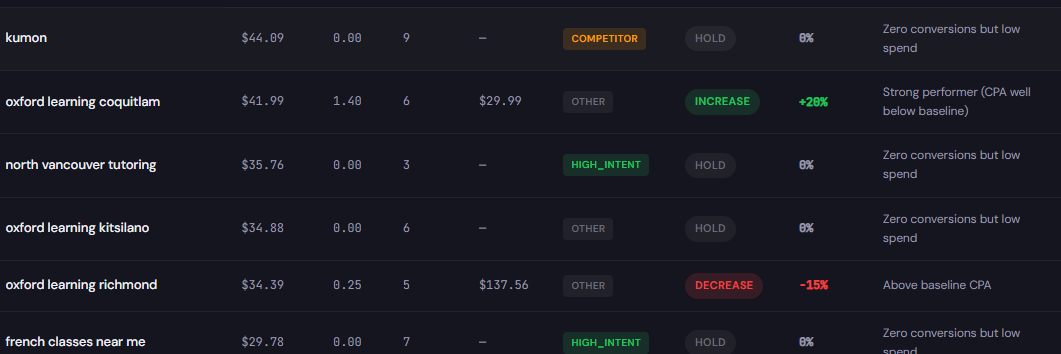
What it outputs: A ranked table of search terms with spend, conversion metrics, tags (e.g., candidate for negative, move to SKAG), and recommended bid actions by keyword.
How to use it — 3 steps
- Upload your search-terms report (30 days). The tool flags high-cost, no-convert queries and suggests bid adjustments.
- Accept recommended negatives and export a bid-action CSV for Editor or apply changes manually for priority terms.
- Monitor performance for 7 days; re-run and tighten the negative list and adjust bids on remaining candidates.
Using the two tools together: run the wastage snapshot first to prioritize which campaigns to triage, then use the search-term analyzer to fix the biggest leakage terms and produce Editor-ready bid/negative exports.
90-minute account triage playbook
- 0–10 min: Pull last 30 days: search terms, campaigns by cost, hour-of-day report, ad performance, landing page conversion rates.
- 10–30 min: Run ExecWrite Wastage Snapshot and scan top 5 leaks; create a quick action list (negatives, pause, bids).
- 30–50 min: Run Search Term Analyzer for the top 3 high-cost campaigns; tag negatives and export bid actions.
- 50–70 min: Apply top 5 negatives, set temporary bid caps, and adjust ad schedule modifiers.
- 70–90 min: Launch two landing-page headline variants for top traffic campaigns and schedule a 7-day check-in with metrics to watch (CPA, CTR, conversion rate, cost).
- Follow-up: At day 3 and day 7, re-run the tools and compare reclaimed spend vs. baseline; freeze successful settings into the account structure.
Run the snapshot, export search-term fixes, and apply quick actions — all from one place. Recover wasted budget within days.
FAQ
Most accounts see immediate click reductions and lower cost within 24–72 hours. Conversion improvements take longer as automated bidding recalibrates; check for signal changes at day 3 and day 7.
Not always. If automation is driving high-cost volume, set conservative caps first. For risky accounts, pause or switch to a manual strategy for prioritized campaigns until you stabilize signal.
Run a snapshot monthly for maintenance and immediately after major structural changes (new feeds, large budget moves, or seasonal shifts).
Yes. The search-term analyzer produces export-ready CSVs for negatives and bid-action lists; the wastage snapshot gives a recovery plan you can convert to Editor changes quickly.
Leave a Reply