If your account used to hit targets but now swings between profitable and broke, this playbook gives operator-level steps to find the leaks and fix them fast. Use the checklist, run the quick audits, and try the tools at ExecWrite to automate recovery tasks.
- Major causes: poor search-term control, misaligned audiences/landing pages, time-of-day volatility, and untracked conversions.
- Quick wins: recover wasted spend, apply hourly/daypart bid adjustments, and shore up keyword intent with negative lists.
- Use two focused tools — the Wastage Snapshot & Recovery and the Search Term Analyzer — to generate prioritized actions you can apply this week.
Table of Contents
Why PPC feels harder now
Advertisers report higher CPA volatility, more wasted clicks, and decreased clarity from automated bidding. The root cause is not a single Google change — it’s a mix of shifting user intent, automation that reduces manual signal visibility, and account drift (ads, landing pages, and keywords becoming misaligned over time).
That combination makes traditional hygiene (negatives, match-type structure, ad-copy tests) necessary but not sufficient. You need focused audits and outputs that produce executable changes — not more reports.
The 5 biggest PPC problems marketers face
1) Wasted spend from poor search-term control
- Symptoms: Lots of low-intent clicks, high spend on irrelevant queries, conversion rate declining while clicks rise.
Why it happens: Broad/adaptive match types without a tight negative strategy allow irrelevant queries to siphon budget. Accounts rarely audit search terms at scale.
- Fix this week: Export last 90 days of search terms, tag irrelevants, and add top 20 negatives now.
2) Misaligned ad-to-landing relevance (Quality Score leaks)
- Symptoms: High impressions and clicks but low conversion rate; Quality Score below account average.
Why it happens: Messaging drift — ads or keywords don’t match the landing page offer or headline. Small copy mismatches multiply at scale.
- Fix this week: Map top 10 ad groups to landing pages, test headline alignment, and implement matched headlines or specific landing pages for the highest-traffic groups.
3) Hourly/daypart swings causing inefficient bidding
- Symptoms: CPA varies by hour or day by 2x–5x; automated bids chase poor-hour conversions.
Why it happens: Aggregated bidding ignores hour-level patterns. Without hour-of-day adjustments you’ll keep overpaying in costly low-conversion windows.
- Fix this week: Pull hourly performance for your main campaigns and add a conservative ad schedule or hourly bid modifiers for identified windows.
4) Untracked or misattributed conversions
- Symptoms: Conversion counts drop after changes; last-click CPA looks worse than business reality.
Why it happens: Tagging breaks, duplicate tracking, or a move to server-side/consent-driven environments without proper configuration.
- Fix this week: Confirm conversion actions in Google Ads, compare with GA4 and CRM, and re-enable missing goals or import conversions.
5) Campaign structure and keyword bloat
- Symptoms: Large campaigns with mixed intent keywords, poor ad relevance, and inconsistent bids.
Why it happens: Years of incremental keyword additions and reactive fixes create bloated structures that confuse automated bidding and reduce clarity of signal.
- Fix this week: Identify top-spend ad groups and split high-intent vs low-intent keywords into separate groups or campaigns for clearer bids and ads.
Fixes you can apply this week
- Run a 90-day search-term export; flag and add top negatives (start with the top 20 by spend).
- Map top 10 ad groups to landing pages; change headlines or page sections to match intent.
- Pull hour-of-day performance for main campaigns and set conservative bid modifiers for loss-making hours.
- Audit conversion actions across Google Ads, GA4, and CRM; reconcile discrepancies and re-import missing conversions.
- Split bloated ad groups by intent and create explicit ad-copy for each intent bucket.
Run a Wastage Snapshot to identify top leakage and a Search Term Analyzer to generate negative lists and bid guidance in minutes.
Tool-based workflow: map problems to two ExecWrite tools
Wastage Snapshot & Recovery — what it outputs
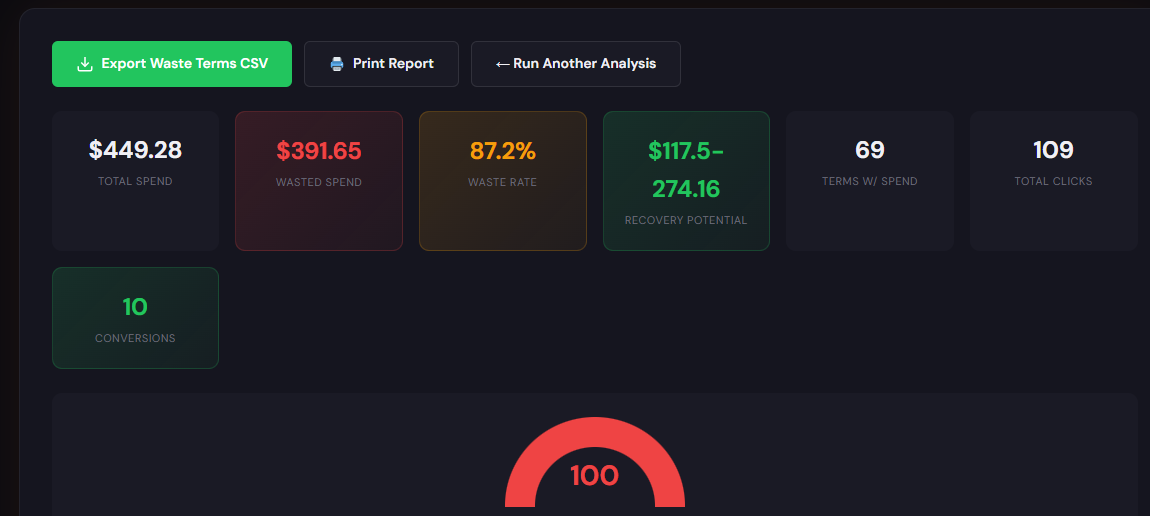
The Wastage Snapshot produces an account-level dashboard that highlights top budget leaks, keyword and campaign waste estimates, and a prioritized recovery plan with specific actions (negatives, budgets to cut, campaigns to pause).
How to use it in 3 steps
- 1) Upload a CSV or connect your Google Ads export to generate the snapshot.
- 2) Review the recovery plan: top wasted queries, irrelevant audiences, and suggested budget reallocations.
- 3) Export the recommendations and apply negatives/ad-schedule changes directly in Google Ads Editor or via the UI.
Preview and try: Wastage Snapshot & Recovery
Search Term Analyzer (Bid Adjustment by Search Term) — what it outputs
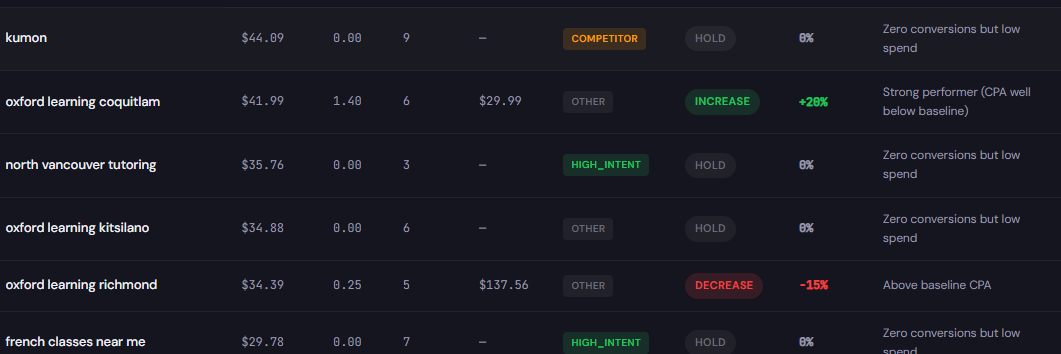
The Search Term Analyzer gives a ranked table of search terms with spend, conversions, suggested tags (negative/keep), and recommended bid actions. It also provides hourly bid adjustment guidance when you use the Hourly Bid Adjuster module.
How to use it in 3 steps
- 1) Upload your search-term export (last 90 days) into the analyzer.
- 2) Review tags and bulk-select terms to add as negatives or to keep. Use the recommended bid adjustments for high-intent queries.
- 3) Export a negatives CSV and an action file for Google Ads Editor, and apply a targeted bid increase for top converters during high-performing hours.
Preview and try: Search Term Analyzer
90-minute account triage playbook
- 0–10m: Pull last 90 days search terms, campaign performance, and conversion action list.
- 10–25m: Run Search Term Analyzer on the export; add top 10 negatives and flag top 10 converting queries.
- 25–40m: Run Wastage Snapshot; prioritize top 3 campaigns by waste score.
- 40–55m: Implement quick changes — pause the worst-performing ad group, apply negative lists, and set conservative budget cuts for leak campaigns.
- 55–70m: Pull hour-of-day report for top campaigns and apply ad schedule/bid modifiers for poor hours.
- 70–80m: QA conversion tracking: verify tags, goals, and import status.
- 80–90m: Document changes, schedule a 7-day review, and export the next steps (negatives, ad-copy updates, landing page priorities).
Run a Wastage Snapshot and the Search Term Analyzer to generate exportable action files you can apply in Google Ads Editor today.
FAQ
Small hygiene fixes (negatives, ad schedule cuts) can reduce wasted spend within 48–72 hours. Expect conversion-rate improvements to show in 7–14 days after landing page or ad-to-page alignment changes.
No — these tools generate recommended actions (negatives, bid modifiers, ad-schedule changes) that you apply manually or via Ads Editor. They don’t change your automated bidding algorithms directly.
You only need export-level data (search term, campaign, hourly performance). For automated connects, an admin user is required; for CSV uploads you can run audits without granting access.
The tools identify waste and produce a recovery plan to stop future waste; they also surface quick negative opportunities and misconfigurations so you can reclaim budget for profitable paths going forward.
Sources
- Google Ads: About Quality Score
- WordStream: Why PPC budgets get wasted (common causes)
- HubSpot: What is PPC and how paid search works
- Search Engine Journal: How automated bidding affects signal visibility
Need a hands-on recovery? Start with a quick Wastage Snapshot and Search Term Analyzer run at ExecWrite to get exportable actions you can apply today.
Leave a Reply