If your account feels expensive and results are shrinking, you need a repeatable triage and quick fixes—no theory. This guide walks a technical PPC operator through the exact checks, quick wins, and a tool-based workflow (using ExecWrite) to stop budget leakage fast. For hands-on audits and automated recommendations, see the tools at ExecWrite.
- Wasted spend usually comes from loose keyword match, poor negatives, ad/landing misalignment, and time-of-day mismatches.
- Run a 90-minute triage: wastage snapshot, high-spend search term audit, ad-to-landing relevance checks, and quick bid schedule fixes.
- Use ExecWrite’s Wastage Snapshot and Search Term Analyzer to produce recovery actions and bid recommendations you can deploy this week.
Table of Contents
Why PPC feels harder now
Expectations are higher, competition and automation obscure signal, and platforms reward scale over precision. That combination makes wasted spend visible only after the budget is burned. Operators must diagnose with data-first checks, not guesses.
The 5 biggest PPC problems marketers face
1. Uncontrolled search-term waste
Symptoms
- High spend on irrelevant queries with zero conversions.
- Many low-intent modifiers (e.g., “free”, “how to”) triggering broad or phrase matches.
- Repeated spend on single-word or generic queries.
Why it happens
Broad match and Smart Bidding mask keyword-level problems; without a weekly search-term audit, low-intent queries compound.
Fix this week
- Export last 30 days of search terms, sort by cost, and flag top 20 irrelevant queries for negatives.
- Create negative keyword lists scoped by campaign intent (brand vs. non-brand).
- Move high-cost, high-intent terms into exact-match ad groups with tailored ads and landing pages.
2. Poor ad-to-landing-page relevance (Quality Score drain)
Symptoms
- Low CTR versus competitors, high CPCs, and falling conversion rates.
- Ad copy promises not reflected on the landing page (different offer, different pricing).
- Ad groups with many disparate keywords share a single generic landing page.
Why it happens
Scaling fast often means reusing ads and pages. That creates relevance gaps that increase CPC and reduce conversions.
Fix this week
- Audit top 10 ad groups by spend; check headline-to-LP headline match and call-to-action consistency.
- Create at least one variant landing page for the worst-performing ad group.
- Prioritize ad-to-LP alignment for high-volume keywords to improve Quality Score.
3. Time-of-day and dayparting mismatch
Symptoms
- CPA/ROAS swings by hour of day; high cost during low-conversion hours.
- Blanket bid changes that ignore hour-level signal.
- Manual ad schedule changes based on intuition, not hourly data.
Why it happens
Many accounts use daily aggregate metrics while conversion behavior is hourly. Automation needs reliable, hourly signal to make correct schedule decisions.
Fix this week
- Pull hour-of-day performance for the last 30 days and identify 3 worst hours by CPA or ROAS.
- Apply temporary ad-schedule bid adjustments (-25% to -50%) on low-performing hours and monitor 7 days.
- Run a controlled test: restrict a campaign to peak hours and compare cost per conversion.
4. Budget leaks from poor campaign structure
Symptoms
- Multiple campaigns competing for same keywords or audiences.
- High spend in generic campaign while niche campaigns starve.
- Shopping or Discovery campaigns absorbing brand queries.
Why it happens
Campaign overlap and overlapping audiences create internal competition and inconsistent pacing, amplifying wasted spend.
Fix this week
- Check auction insights and search term overlap across campaigns; pause duplicates.
- Use negative campaign-level keywords to stop overlap (brand negatives in generic campaigns).
- Reallocate budget toward campaigns with demonstrable ROI signals.
5. Automation misfires (wrong signals feeding bids)
Symptoms
- Smart bidding increases spend without conversion lift.
- Signals are sparse: small accounts or new campaigns show volatility.
- Sudden swings after feed or conversion tracking changes.
Why it happens
Algorithms need clean inputs. Bad conversion data, conversion-value inflation, or sparse events lead to poor automated decisions.
Fix this week
- Validate conversion tracking and remove duplicate/low-value conversions from bidding goals.
- Lower bid aggressiveness (target CPA/ROAS buffers) and add bid limits for high-variance campaigns.
- Run a diagnostics pass: compare automated campaigns to a control manual campaign for 14 days.
Fixes you can apply this week
- Run a 30-day Wastage Snapshot to identify top leakage areas (campaigns, keywords, devices).
- Export search terms for past 30 days; add top irrelevant terms as negatives and pull top converting queries into exact match.
- Match ad headlines to landing page headlines for your top 10 ad groups by spend.
- Identify 3 low-performance hours and apply conservative ad-schedule bid cuts.
- Audit conversion setup: remove low-value conversions from bid targets and verify event deduplication.
Use ExecWrite’s Wastage Snapshot to get an automated recovery plan and prioritized remediation list in minutes.
Tool-based workflow
Below are two focused tools from ExecWrite that map directly to the top problems above. Each entry shows what the tool outputs and a 3-step usage pattern. Preview images are included to set expectations.
Wastage Snapshot & Recovery
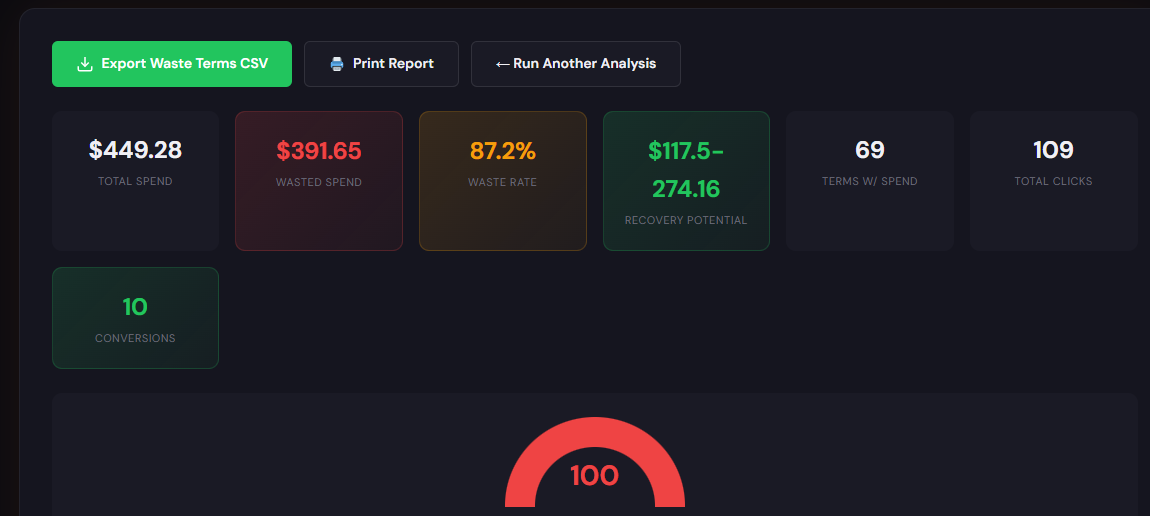
What it outputs: A dashboard-style snapshot that quantifies wasted spend, lists top leakage sources (search terms, campaigns, devices), and gives prioritized recovery actions.
How to use it (3 steps)
- Upload a 30–90 day account export or connect your account to generate a snapshot.
- Review the top 5 leakage items and their estimated recoverable spend—prioritize by ROI lift.
- Apply recommended negatives, budget shifts, and ad schedule changes; re-run the snapshot weekly to track recovery.
Open the Wastage Snapshot for a guided audit and recovery plan.
Search Term Analyzer (Bid Adjustment by Search Term)
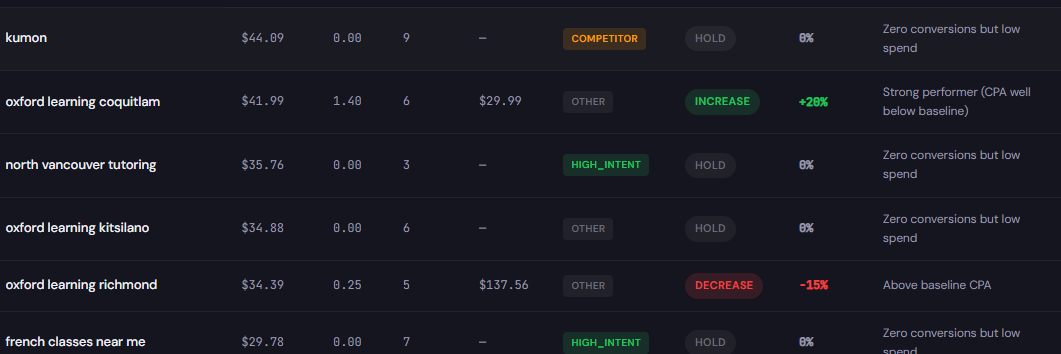
What it outputs: A spend-ranked search-term table with conversion metrics, intent tags, and suggested bid actions (add negative, keep, promote to exact match).
How to use it (3 steps)
- Run the analyzer on 30–90 day search term data to surface high-cost irrelevant terms and high-potential queries.
- Tag terms as negative/promote and apply the suggested actions in bulk to reduce immediate waste.
- Export decisions to Google Ads Editor or deploy directly and monitor 7–14 days for cost-per-conversion changes.
Open the Search Term Analyzer and start converting insights into negatives and bid recommendations.
90-minute account triage playbook
Run this sequence with a single log-in and a distraction-free 90 minutes.
- Minutes 0–10: Export basic reports—search terms, hour-of-day, top campaigns by spend, conversion actions.
- Minutes 10–30: Run ExecWrite Wastage Snapshot and note top 3 recovery recommendations.
- Minutes 30–50: Run Search Term Analyzer; tag top 20 irrelevant terms and promote top converting queries to exact-match ad groups.
- Minutes 50–70: Apply quick ad/landing fixes for the top 5 ad groups (headline alignment, CTA consistency).
- Minutes 70–80: Set conservative ad-schedule adjustments for the 3 worst hours identified.
- Minutes 80–90: Document changes, schedule a 7-day recheck, and create tasks to implement any landing page work or structural fixes.
Run both the Wastage Snapshot and Search Term Analyzer to get prioritized remediation exported as actions. Save hours on manual diagnostics.
FAQ
Expect to see immediate reductions in irrelevant clicks within 24–72 hours. Full conversion-rate effects can take 7–14 days as traffic mixes stabilize.
Smart bidding won’t remove negatives, but campaign or asset changes might. Keep a changelog and re-run your analysis after major automation updates.
Focus on structural fixes: match-type tightening, exact-match promotion, and landing page alignment. Use conservative bid strategies until signal grows.
ExecWrite offers both free and paid tools. The Search Term Analyzer has a free version for basic audits; Wastage Snapshot provides a fast paid snapshot and recommendations. Start at ExecWrite.
Sources
- Google Ads Help – About Quality Score — explains relevance and Quality Score drivers.
- WordStream – Google Ads Resources — practical guides on common PPC misconfigurations and negative keywords.
- Search Engine Journal – Negative Keywords Guide — best practices for negative keyword strategies and list management.
Leave a Reply