If your account is drifting—rising CPA, falling conversion rates, or noisy search terms—you need a fast, operational plan. Use this guide and the tools at ExecWrite to triage waste, prioritize fixes, and lock in measurable wins.
- Most underperforming Google Ads accounts suffer the same root causes: wasted spend, poor intent matching, broken measurement, rigid bidding.
- Run a focused 90-minute triage: quick waste audit, search-term cleanup, ad/landing alignment, and hourly bid checks.
- Use two ExecWrite tools—the Wastage Snapshot and the Search Term Analyzer—to produce prioritized actions in minutes.
Table of Contents
Why PPC feels harder now
Automation, shifting intent, and thinner signal (privacy changes, conversion delays) make results noisier. Bids move faster than teams can react; reports lag; and small leaks compound into large wasted spend. That means tactical, human-led triage matters more than ever: stop the bleeding, restore signal, then hand control back to automation with cleaner inputs.
The 5 biggest PPC problems marketers face
Pain 1 — Wasted spend (low-intent clicks)
Symptoms
- High cost with few or no conversions
- High bounce rates / very low time-on-site from paid traffic
- High spend on long-tail or irrelevant search terms
Why it happens
Broad match expansion, aggressive automated bidding, and missing negative keywords let low-intent queries drain budgets. Automation optimizes to the available signal, which can be dominated by irrelevant clicks if the account isn’t curated.
Fix this week
- Run a search-term report and tag clearly irrelevant terms for immediate negatives.
- Pause low-converting long-tail ad groups with high CPA.
- Temporarily tighten match types on your top-spend campaigns.
Pain 2 — Poor ad-to-landing relevance
Symptoms
- Low CTR vs. expected benchmarks
- High impression share but low conversion rate
- Quality Score or landing page warnings in Google Ads
Why it happens
Ad copy and landing pages drift apart as new offers or pages are added. Automation can’t compensate for messaging mismatch; users click but don’t convert because expectations aren’t met.
Fix this week
- Map top-performing ad headlines to landing page headlines for top 10 ad groups.
- Swap landing pages for campaigns with conversion drops to a proven page.
- Add transparent CTAs and match form fields to ad promises.
Pain 3 — Bidding instability and time-of-day losses
Symptoms
- Big hour-to-hour swings in CPA/ROAS
- Ad scheduling not aligned to conversion windows
- Automated bid strategies overreacting to short-term noise
Why it happens
When conversion volume is low or delayed, bid algorithms overfit to noisy windows. Missing dayparting or hourly insights means bidding is not matched to actual demand patterns.
Fix this week
- Analyze hour-of-day conversion patterns and set conservative ad schedules.
- Use hourly bid adjustments to stabilize peak/no-peak hours.
- Lower bid aggressiveness temporarily to avoid bounce from automation.
Pain 4 — Measurement gaps and conversion lag
Symptoms
- Last-click vs. data-driven attribution differences
- Conversion delays creating noisy daily reports
- Underreported conversions in Google Ads vs. GA4
Why it happens
Missing or misconfigured tracking, consent pop-ups blocking pixels, and cross-domain issues cause partial signal. Automated bidding requires reliable, timely conversions to work well.
Fix this week
- Verify conversion tags, server-side events, and GA4 linkage.
- Set up a secondary micro-conversion to capture early intent signals.
- Document and adjust for conversion lag in reporting windows.
Pain 5 — Creative fatigue and message mismatch
Symptoms
- Declining CTR for once-high-performing ads
- Many ad variations with no clear winner
- Low impression share for top keywords despite budget
Why it happens
Ads get stale and stop resonating; campaigns rely on single creative that ages. Without a rolling creative plan, performance decays faster than you can test replacements.
Fix this week
- Pause ads older than 90 days that are underperforming.
- Swap in 3 headline/body variants aligned to your best-converting landing pages.
- Run a small A/B test to validate messaging before broad rollout.
Fixes you can apply this week
- Export top 10 campaigns by spend and run a waste-first audit (search terms + landing page mismatch).
- Apply negative keywords and pause irrelevant ad groups (start with top spenders).
- Check Quality Score and align headlines to landing pages for the top 20 ad groups.
- Analyze hour-of-day CPA and apply conservative bid adjustments to off-peak hours.
- Confirm tracking: conversion tag fires, GA4 links, and a micro-conversion to feed bidding.
- Reinforce automated bidding with cleaned audiences and explicit exclusions.
Use ExecWrite’s Wastage Snapshot to find leaks and prioritized recovery actions in minutes.
Tool-based workflow: map problems to ExecWrite tools
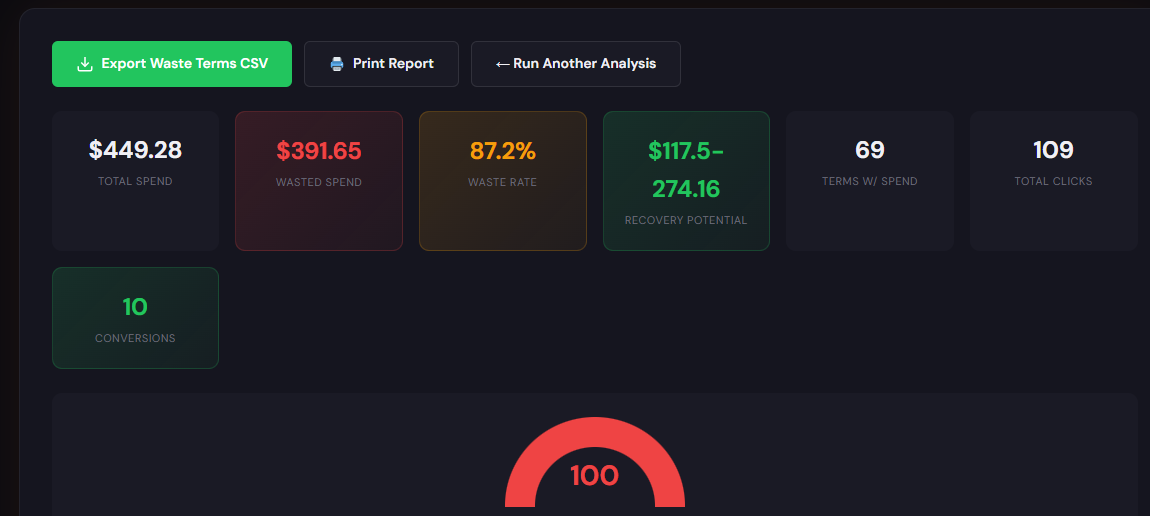
What it outputs: A dashboard showing total wasted spend, top leakage areas, negative keyword suggestions, and a prioritized recovery plan.
How to use (3 steps)
- Upload or connect your Google Ads account to generate the snapshot (minutes).
- Review the top 5 leak categories and apply suggested negatives or pauses directly in your account.
- Export the prioritized recovery plan and assign fixes with owners and deadlines.
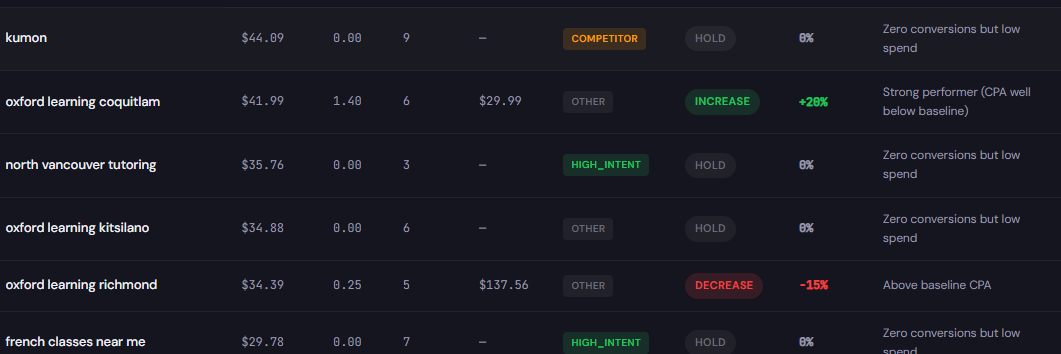
What it outputs: A table of search terms with spend, conversions, intent tags, and recommended bid actions (raise, lower, negative).
How to use (3 steps)
- Generate the search-term report for the target campaign or date range.
- Tag and filter terms into buckets: high-intent, ambiguous, negative candidates.
- Bulk-apply bid adjustments or negative keyword lists; re-run weekly to tighten inputs to automation.
Both tools combine to stop waste (Snapshot) and control bid inputs (Search Term Analyzer). Start with the Snapshot to prioritize, then use the Analyzer to make surgical bid and negative changes.
90-minute account triage playbook
- 0–10 min: Pull top 10 campaigns by spend, check live conversion tracking and notifications.
- 10–30 min: Run ExecWrite Wastage Snapshot; apply top 3 negative keyword suggestions immediately.
- 30–50 min: Export search-term report for top spenders and load into Search Term Analyzer; tag negatives and quick wins.
- 50–70 min: Check hour-of-day CPA swings; apply conservative ad schedule/bid adjustments for off-peak hours.
- 70–85 min: Review top 20 ad groups for headline-to-landing-page mismatch; swap landing pages or ads for immediate alignment.
- 85–90 min: Document actions, set owners, and schedule a 7-day check to measure impact. Hand cleaned inputs back to automated bidding.
Run both the Wastage Snapshot and Search Term Analyzer to convert a 90-minute audit into an executable recovery plan.
FAQ
A:
Quick wins from negatives and pausing bad ad groups often show impact within 48–72 hours. Stabilizing bidding and creative tests can take 7–14 days to validate.
A:
Properly done, cleaning improves automated bidding performance by feeding higher-quality signals. Start conservatively and monitor closely to avoid sudden bid shocks.
A:
Start with the Wastage Snapshot to identify the largest leaks. Then run the Search Term Analyzer to convert those insights into precise bid and negative actions.
A:
Most accounts can run both tools with standard Google Ads access. If you use server-side tracking or complex cross-domain setups, involve your developer for verification steps.
Sources
- How automation changed PPC (Search Engine Land) — context on automation’s effects on bidding and account drift.
- How PPC waste happens and what to do about it (WordStream) — practical waste categories and mitigation tactics.
- About Quality Score (Google Ads Help) — guidance on ad relevance and landing page alignment.
- Common PPC mistakes and fixes (HubSpot) — operational checklist items and testing approaches.
Leave a Reply