If your account feels expensive, noisy, or unpredictable, you need a compact triage and fixes you can apply this week. This article walks through the five root problems, immediate checklists, and a tool-driven workflow using ExecWrite to recover wasted spend. Learn faster remediation steps at ExecWrite.
- Most underperformance stems from wasted impressions, poor search-term control, and mismatch between bids and hour-of-day performance.
- Apply five quick checks this week: waste snapshot, search-term audit, daypart bids, quality-score review, and campaign structure fixes.
- Use two ExecWrite tools to automate the triage: Wastage Snapshot & Recovery and Search Term Analyzer for targeted bid actions.
Table of Contents
Why PPC feels harder now
Advertisers face higher CPCs, more automation, and noisier intent signals. Platforms push broad-match, smart bidding, and real-time auctions — which amplify weak structures and create fast leakage. Without strong guardrails (negative keywords, dayparting, and ad-to-landing relevance), accounts degrade quickly. The fixes are operational: triage, rules, and surgical changes rather than more budget.
The 5 biggest PPC problems marketers face
1. Wasted spend and budget leakage
Symptoms
- High spend with flat or falling conversions
- Lots of clicks from irrelevant terms or low-intent pages
- Unexplained daily spend spikes
Why it happens
Broad match plus aggressive automated bidding can siphon budget to low-intent queries and placements. Without ongoing snapshots and negative keyword curation, waste compounds across campaigns.
Fix this week
- Run a quick wastage snapshot to identify top leakage areas.
- Pause or reduce bids on poorest-performing campaigns/ad groups for 7 days.
- Export top-spend queries and add negatives on sighted irrelevancies.
2. Search-term chaos (bad keyword signal)
Symptoms
- Conversions concentrated in a small subset of search terms
- High spend on dozens of one-off queries
- Hard-to-justify broad-match traffic
Why it happens
Broad match and phrase match without ongoing pruning lets non-converting queries scale. Manual reviews miss low-volume but high-cost terms; you need tools that recommend targeted bid actions and tag terms for negatives.
Fix this week
- Run a search-term analyzer to tag high-cost/low-conversion queries.
- Add clear negatives and move converting queries into exact-match ad groups.
- Set a temporary lower bid modifier for broad-match heavy ad groups.
3. Hour-of-day bid mismatches (bad dayparting)
Symptoms
- CPA/ROAS swings by hour are >50%
- Conversions cluster in a narrow daily window
- Ad schedule is flat despite obvious peaks
Why it happens
Default ad schedules and automated bidding can miss fine-grained hourly patterns. When conversion rate varies by hour, static bids waste budget in off hours and under-bid during peaks.
Fix this week
- Pull hourly performance and apply conservative bid cuts where CPA spikes.
- Create ad schedule segments (peak, shoulder, off) and apply bid modifiers.
- Test a 7-day window before committing full schedule changes.
4. Low Quality Score and landing page mismatch
Symptoms
- High CPCs on specific keywords despite strong bids
- Low CTR on ads that mirror landing pages
- High bounce rate on traffic from certain ad groups
Why it happens
Quality Score reflects ad relevance, expected CTR, and landing page experience. Messaging disconnects and slow or irrelevant landing pages hurt both CPC and conversion rate.
Fix this week
- Audit top 10 keywords with the worst Quality Score; align headlines and landing content.
- Swap low-performing landing pages for variant tied to ad group intent.
- Add quick A/B landing page edits focused on headline and CTA match.
5. Broken campaign structure and cannibalization
Symptoms
- Multiple ad groups bidding on overlapping keywords
- Fluctuating impression shares across similar ad groups
- Confusing reporting that hides true ROI per funnel stage
Why it happens
Accounts built up over time often accumulate overlapping ad groups, orphan keywords, and inconsistent naming conventions. That prevents scale and makes automation unpredictable.
Fix this week
- Identify overlapping keywords and consolidate into clearer match-type buckets.
- Use a campaign naming standard and move converting queries to dedicated ad groups.
- Remove or pause duplicate audiences and rule-based overlaps.
Fixes you can apply this week
- Run a wastage snapshot to get a top-down leakage map.
- Export top search terms (last 30 days) and add negatives for irrelevancies.
- Segment hourly performance and set temporary bid modifiers for off-peak hours.
- Move consistent converters into exact-match ad groups and tighten match types on low performers.
- Audit top landing pages for headline/CTA relevance and deploy one focused rewrite per page.
- Pause campaigns/ad groups with CPA > target for 7 days while you audit.
Use the Wastage Snapshot to identify top leakage, negative keyword opportunities, and quick recovery actions in minutes.
Tool-based workflow
Below are two focused ExecWrite tools that convert the diagnosis above into outputs you can action immediately.
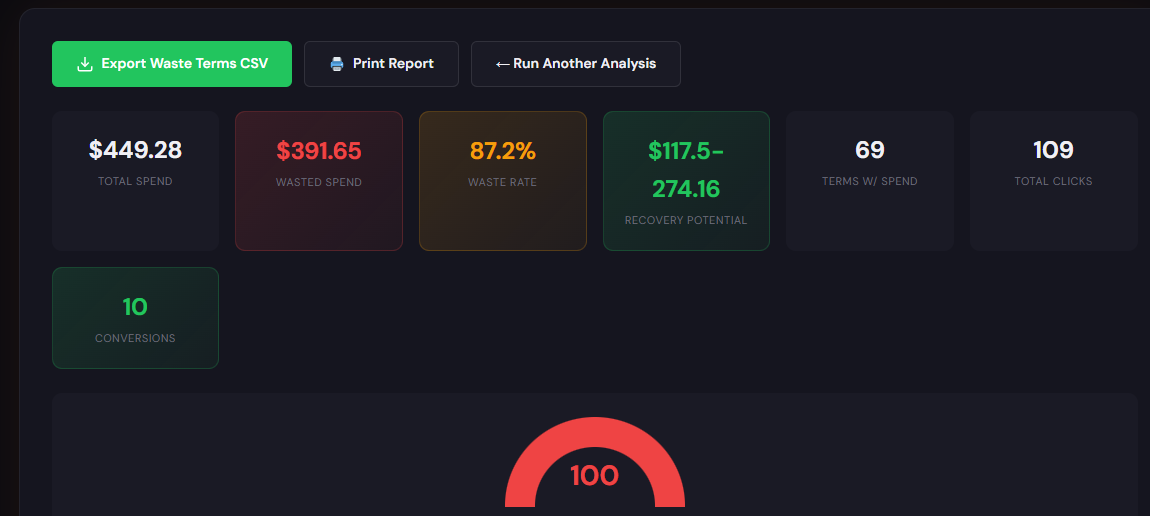
What it outputs: Dashboard-style snapshot listing wasted spend by campaign, top leakage areas, negative keyword candidates, and a prioritized recovery checklist.
How to use it (3 steps)
- Upload a 30-day account export or connect the account for a quick scan.
- Review the top 10 leakage items and export the negative keyword candidates.
- Apply high-confidence negatives and schedule paused bids for low-performing campaigns; rerun after 7 days.
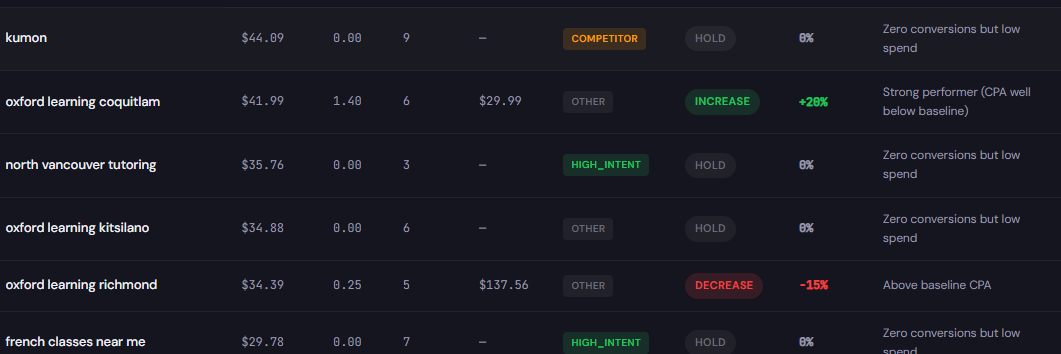
What it outputs: Row-level search-term table with spend, convs, CPA, recommended bid action (raise, lower, negative), and tagging for easy imports.
How to use it (3 steps)
- Export search terms for the last 30 days and load the file into the analyzer.
- Review recommended actions; accept ‘negative’ tags and export a negatives list, or export bid adjustments for bulk upload.
- Import recommended bid adjustments into Google Ads Editor or via rules; monitor the next 7–14 days.
90-minute account triage playbook
A focused, time-boxed runbook to stabilize an account in one session.
- 0–10 min: Snapshot. Run the Wastage Snapshot or pull top-line metrics (spend, convs, CPA, impression share) to spot obvious leaks.
- 10–30 min: Search-term triage. Export search terms and run the Search Term Analyzer. Tag negatives and highest-cost offenders.
- 30–50 min: Apply immediate actions. Push high-confidence negatives and pause worst-performing ad groups/campaigns.
- 50–70 min: Daypart check. Pull hourly data and set temporary bid modifiers (reduce off-peak, raise shoulder/peak where conversions occur).
- 70–90 min: Landing page and quality checks. Review top 3 landing pages; fix headline/CTA mismatches or swap to a better-performing variant.
Get a guided wastage audit and search-term actions exported in minutes. Recover wasted spend and convert the findings into Google Ads imports.
FAQ
Most bids and negatives show impact within 24–72 hours; measurable conversion lift often appears in 7–14 days once waste is removed and bid adjustments settle.
Smart bidding helps but relies on clean inputs. If your account has leakage, cross-campaign cannibalization, or poor landing relevance, automation will optimize around the noise. Fix structure first, then let automation scale.
No. The triage is procedural and tool-driven. ExecWrite outputs actionable files (negatives, bid adjustments) you can apply directly or hand to a partner.
Start with 30 days for immediate problems; expand to 90 days for seasonality or low-volume accounts.
Short, surgical pauses and bid modifiers stabilize signals. Document changes and avoid wholesale automation toggles during the first 14 days after major edits.
Sources
- Google Ads Help — About Smart Bidding
- Search Engine Journal — How to Reduce Wasted Ad Spend
- WordStream — Google Ads Benchmarks and Analysis
Ready to run the scans and recover wasted budget? Start with a Wastage Snapshot and Search Term Analyzer at ExecWrite.
Leave a Reply