Google Ads
Marketing Ops
Google Ads accounts stop behaving for predictable reasons: leakage, misaligned bids, poor search-term hygiene, and landing-page mismatch. This guide gives an operator-level triage + fixes you can run this week and shows how two ExecWrite tools accelerate recovery. Learn faster diagnostics at ExecWrite.
- Fix the top 3 leakage areas in 90 minutes: wasted keywords, bad bids by hour, and landing-page mismatch.
- Run these weekly checklists: search-term audit, hour-of-day bid review, and quality-score headline fixes.
- Use two tools—Wastage Snapshot & Recovery and Search Term Analyzer—to automate detection and generate action lists.
Table of Contents
Why PPC feels harder now
Paid media is noisier and more automated. Smart bidding hides signal, audiences fluctuate, and auction dynamics shift faster than manual rules can keep up. That makes simple leaks—irrelevant queries, time-of-day swings, and messaging mismatch—have outsized impact on ROI. You don’t need a full account rebuild; you need targeted fixes and repeatable workflows that a human operator can run weekly.
The 5 biggest PPC problems marketers face
1. Wasted spend on irrelevant search terms
Symptoms
- High impressions and clicks but low conversions from many low-intent queries.
- Long tail of one-off queries driving small but frequent spend.
- Search term report shows variants that should be negatives.
Why it happens — Broad match and loosely structured keyword lists surface many irrelevant queries; automated bidding can amplify low-quality traffic.
Fix this week
- Export 30-day search-term report and sort by spend → low conversions.
- Identify top 20 negative candidates (single-word and unrelated intent).
- Add negatives at account level and move high-cost irrelevant queries to negative campaigns.
2. Hour-of-day performance swings (wrong ad schedule)
Symptoms
- CPA/ROAS swings heavily by hour or day; peak spend happens in low-converting hours.
- Automated bid strategies raise bids across the board without respecting time-of-day patterns.
Why it happens — Aggregated bid strategies ignore micro-patterns; without hourly inspection you bid up on hours that look like volume but not conversions.
Fix this week
- Pull hourly performance for last 30 days, look at CPA/ROAS by hour.
- Set conservative bid adjustments (-20% to -50%) for the worst-performing hours.
- Test reduced budget in low-performing windows for one week and compare.
3. Messaging mismatch: ads vs landing page
Symptoms
- Good CTR but poor conversion rate.
- High bounce rate on landing pages referenced by high-spend ad groups.
Why it happens — Ad copy promises benefits that the landing page doesn’t deliver, harming Quality Score and conversion rates.
Fix this week
- Map top 10 high-spend ad groups to their landing pages and check headline alignment.
- Change landing page headlines to mirror ad intent and primary CTA.
- Run an A/B headline test for highest-spend pages.
4. Over-reliance on automated bidding with poor signal
Symptoms
- Significant weekly swings in CPA after algorithmic adjustments.
- High spend on low-value audiences or queries.
Why it happens — Smart bidding needs clean input. If conversion tracking or campaign structure is noisy, automation optimizes toward bad outcomes.
Fix this week
- Verify conversion tracking and mark one accurate conversion as primary for bidding.
- Segment campaigns: keep experimental/low-quality traffic separate from core buyers.
- Use conservative targets or switch to manual bidding for problem campaigns temporarily.
5. Structural keyword and ad-group chaos
Symptoms
- Broad keyword lists in single ad groups; low relevance and mixed intents.
- Duplicate keywords across campaigns with conflicting bids.
Why it happens — Rapid scaling or handoffs between teams create messy structures that reduce relevance and make bidding inefficient.
Fix this week
- Export current keyword list and group by intent; create new focused ad groups for top 50 keywords.
- Pause duplicate/low-performing keywords and reassign to intent-driven groups.
- Apply single-promised benefit per ad group and realign landing pages.
Fixes you can apply this week
- Download a 30-day Search Terms report; add top-negative candidates to account negatives.
- Run an hourly performance export and set conservative negative bid adjustments for bad hours.
- Identify top 10 landing pages for high-spend ad groups and align headlines to ads.
- Verify & prioritize the conversion you use for bidding; pause campaigns with noisy conversions.
- Consolidate duplicates and create focused ad groups for your top 50 revenue-driving queries.
Run a Wastage Snapshot & a Search Term Analyzer to get a prioritized recovery plan in minutes.
Tool-based workflow: map pain to ExecWrite tools
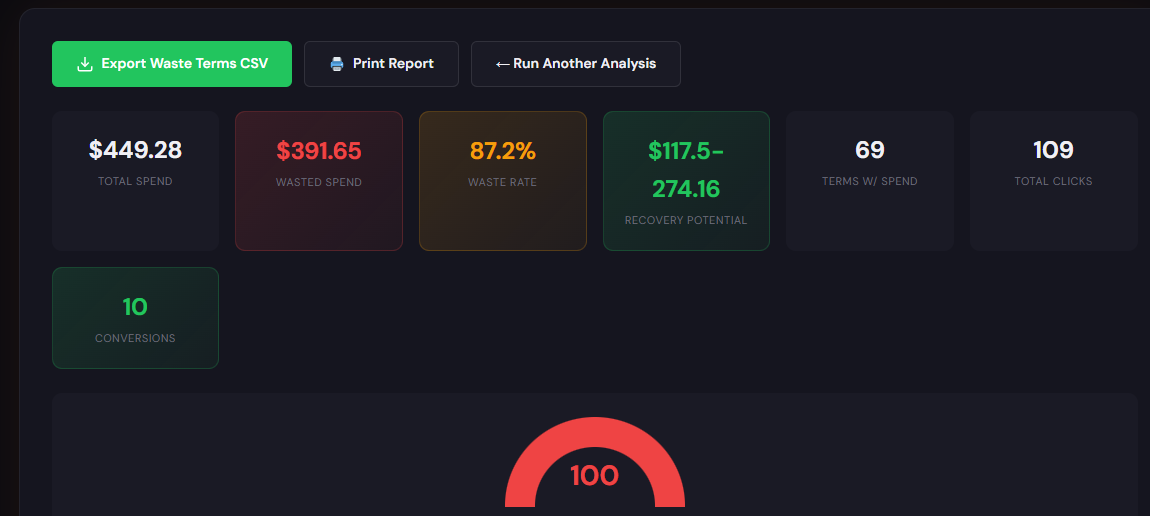
What it outputs: A dashboard that quantifies wasted spend, lists top leakage sources (search-term, campaign, audience), and a recovery plan with prioritized actions.
How to use it (3 steps)
- Run the snapshot on a 30–90 day window to get a waste summary and top leakage areas.
- Export the recovery plan and implement the top 3 recommended changes (negatives, budget shifts, campaign pauses).
- Re-run in 7 days to measure recovered spend and iterate.
Open the Wastage Snapshot & Recovery tool
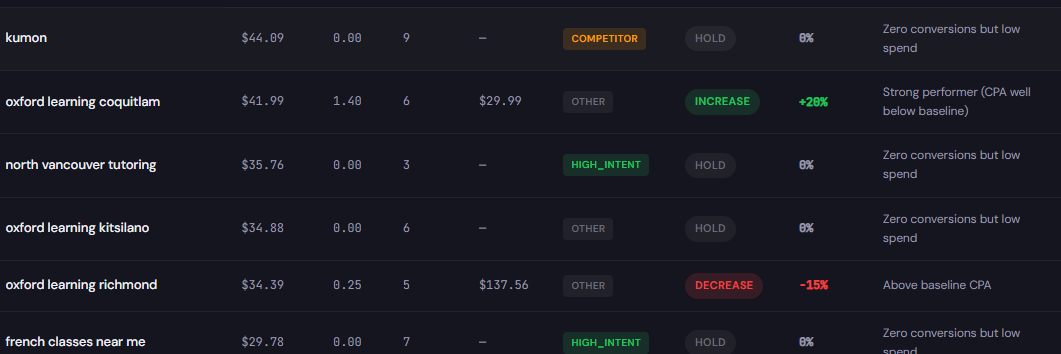
What it outputs: A tagged search-term table with spend, conversions, and recommended bid actions or negative suggestions per term.
How to use it (3 steps)
- Upload your search-term export or connect the data feed; let the analyzer tag intent and flag negatives.
- Apply recommended bid adjustments for high-value terms and add negatives for low-intent queries.
- Use the hour-of-day aggregator (within the suite) to combine term recommendations with time-based bid rules.
90-minute account triage playbook
- 0–10m: Open account overview—check total spend, conversions, CPA change vs prior 30 days.
- 10–30m: Run Wastage Snapshot & Recovery (or scan key reports). Identify top three leakage areas and highest-spend low-conversion campaigns.
- 30–50m: Export search-term report for those campaigns; feed into Search Term Analyzer. Flag top 20 negatives.
- 50–70m: Apply quick actions—add negatives, reduce bids/hour adjustments for worst hours, pause or lower budgets for low-value campaigns.
- 70–90m: Fix messaging—align headlines for top 3 high-spend ad groups to landing page headlines; schedule an A/B test. Document changes and set a 7-day check.
FAQ
Small changes (negatives, bid adjustments, landing-page headline fixes) often show impact within 3–7 days. Structural fixes compound over weeks. Automation + weekly audits speed recovery.
Use them as prioritized signals, not blind rules. ExecWrite tools surface high-confidence negatives and bid suggestions; review the top 20 recommendations before applying account-wide.
Prioritize the conversion that maps to revenue or downstream value. Set that as your primary bid metric, then optimize CPA/ROAS around it.
Weekly for search-term hygiene and hour-of-day checks, monthly for structural cleanup and landing-page tests.
Run the two tools that operators use to generate prioritized action lists in minutes. Start with a snapshot and a search-term audit.
Sources
- Google Ads: About Smart Bidding — explains how automated bidding reacts to noisy signals.
- WordStream: How to find and stop wasted spend — practical negatives and waste-reduction tactics.
- Search Engine Journal: Negative keyword strategy — guidance on negative keyword hygiene and structure.
Leave a Reply