If your paid media numbers are trending down, this is the triage playbook you need. Read fast, act faster, and use tools from ExecWrite to automate the busy work so you can focus on strategy and recovery.
- Most PPC slippage comes from wasted spend, keyword noise, and poor bid timing—not mysterious algorithm changes.
- Apply five quick checks this week (waste audit, search term pruning, landing page alignment, dayparting, and manual bid nudges).
- Use two ExecWrite tools to speed recovery: the Wastage Snapshot for fast audits and the Search Term Analyzer for automated bid & keyword actions.
Table of Contents
Why PPC feels harder now
In a world of automated bidding, privacy changes, and rising CPCs, the margin for sloppy setup is smaller. Automation hides problems until waste compounds. Teams without fast diagnostics and repeatable playbooks are firefighting instead of fixing root causes.
The 5 biggest PPC problems marketers face
Pain 1: Silent wasted spend
Symptoms
- High impressions with low conversion rates across broad match keywords.
- Budget burns with no clear conversion lift after bid changes.
- Reports show cost growing but ROAS falling month-over-month.
Why it happens
Automation and broad match expand reach, but without continual pruning and negative keywords, spend slips into low-intent queries fast.
Fix this week
- Run a waste snapshot to surface top leaking queries and spend buckets.
- Pause or add negatives to the worst 20 search terms by spend.
- Reduce budget caps on high-spend, low-conversion campaigns while you triage.
Pain 2: Search term chaos (wrong intent showing)
Symptoms
- Conversions come from a tiny slice of queries; most clicks are irrelevant.
- Manual negatives are duplicated and inconsistent across accounts.
- Ad groups contain too many distinct intents.
Why it happens
Broad match + loose ad group structure lets every variation surface. Without a process to tag and action search terms, bids and keywords diverge from intent.
Fix this week
- Export the last 30 days of search terms, tag them (convertible, ambiguous, irrelevant).
- Move high-intent queries into dedicated ad groups and tighten match types.
- Centralize negative keyword lists and apply shared negatives to stop repeat leaks.
Pain 3: Poor landing page relevance and Quality Score drops
Symptoms
- Low CTR paired with rising CPCs for previously stable keywords.
- Landing page sessions show high bounce and low form completions.
- Quality Score has dropped without major bid or budget changes.
Why it happens
Small messaging mismatches (headline vs. ad promise) and slow or irrelevant landing pages hurt expected CTR and conversion rate—both feed into Quality Score.
Fix this week
- Audit top-converting ad groups and check ad-to-page message alignment.
- Run a headline and CTA refresh on the worst-performing pages.
- Temporarily shift traffic to higher-converting pages while you iterate.
Pain 4: Bid timing and dayparting mistakes
Symptoms
- Cost per conversion spikes during certain hours or days.
- Bids are uniform across time despite known traffic patterns.
- Automated bid strategies oscillate and never converge.
Why it happens
Accounts often treat time as uniform. Without hour-of-day diagnostics, opportunities to bid up on peak windows and throttle during noise are missed.
Fix this week
- Slice performance by hour/day and flag windows with CPA/ROAS divergence.
- Apply conservative bid multipliers for high-value hours and negative adjustments for waste windows.
- Monitor 48–72 hours and revert if automation over-corrects.
Pain 5: Data gaps and conversion tracking inconsistency
Symptoms
- Conversion counts differ between GA and Google Ads.
- Attribution windows change month to month, hiding trends.
- Cross-domain or multi-step lead flows aren’t tracked end-to-end.
Why it happens
Tracking setups degrade as landing pages, forms, and tag managers change. Missing events make bids and automation work on faulty signals.
Fix this week
- Validate primary conversions in both Google Ads and your analytics tool for the last 30 days.
- Implement server-side or fallback tracking for critical events.
- Lock conversion windows and document attribution rules for the team.
Fixes you can apply this week
- Run a waste snapshot to get top leakage areas (search terms, placements, devices).
- Prune the worst 20 search terms and add them to shared negatives.
- Isolate high-intent queries into tight ad groups and switch to phrase/exact for testing.
- Adjust bids by hour for the top 20% of traffic windows showing CPA variance.
- Refresh landing page headlines to match ad copy and re-measure Quality Score.
- Validate and freeze conversion definitions for 14 days while you stabilize bids.
Use the Wastage Snapshot to identify wasted spend and a prioritized recovery plan in minutes.
Tool-based workflow: map problems to ExecWrite tools
Below are two focused tools that remove the busy work and convert analysis into action. Each includes what it outputs and a three-step usage workflow. Preview images are shown to the left of each tool description.
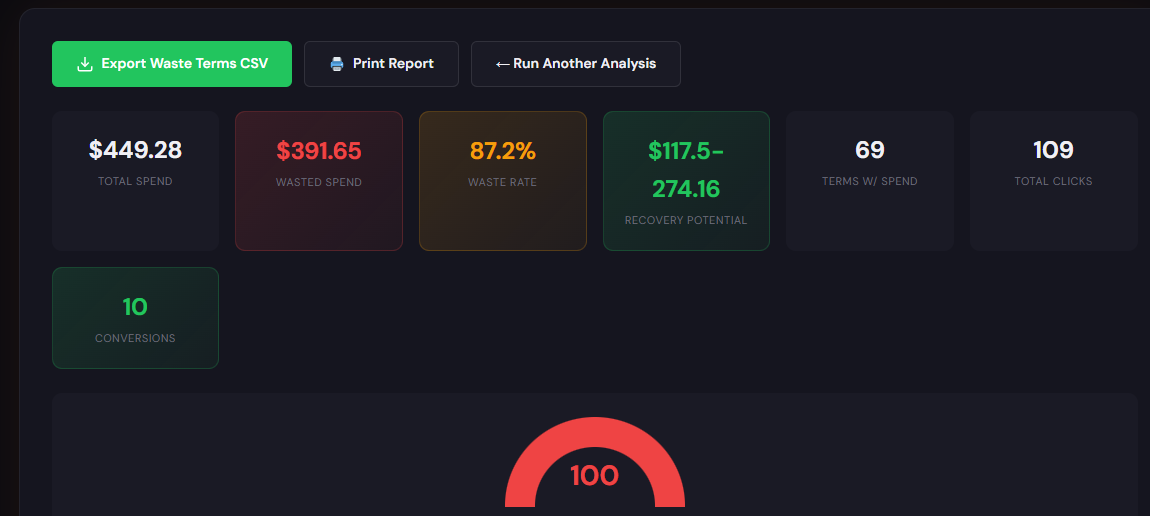
What it outputs: a dashboard snapshot of total wasted spend, the top leakage sources (search terms, placements, devices), and a prioritized recovery plan you can act on immediately.
How to use it (3 steps)
- Upload your Google Ads export or connect the account and run the snapshot to get a ranked waste summary.
- Review the top 5 leakage buckets and export negative keyword suggestions and campaign-level adjustments.
- Apply quick fixes: add the negative list, reduce budgets on leaking campaigns, and schedule a follow-up audit in 7 days.
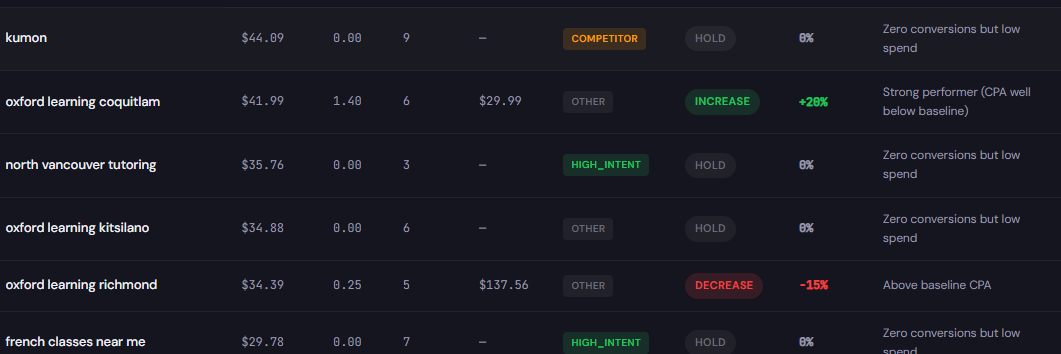
What it outputs: a tagged table of search terms with spend, conversions, intent tags, and recommended bid actions or negative suggestions.
How to use it (3 steps)
- Import the last 30 days of search term data and let the analyzer tag queries into convertible, ambiguous, and irrelevant.
- Review recommended actions: move convertible terms to new ad groups, apply negatives for irrelevant queries, and accept bid adjustments for ambiguous items.
- Export changes as a Google Ads Editor CSV or apply via the UI to execute fast, repeatable hygiene.
90-minute account triage playbook
Follow this timed checklist to stabilize an account in 90 minutes.
- 0–10 min: Snapshot — run the Wastage Snapshot to surface top leakage.
- 10–30 min: Pause — reduce budgets on the worst 2–3 campaigns flagged and set temporary caps.
- 30–50 min: Search-term cleanup — run the Search Term Analyzer, export the top 20 negatives, and apply shared negatives.
- 50–70 min: Quick landing page check — open top landing pages for worst-performing ad groups and verify headline/ad alignment; implement headline swap or canonical redirect.
- 70–85 min: Dayparting — apply conservative hour-of-day bid adjustments for the most divergent hours.
- 85–90 min: Document — write a 1-page summary of changes, expected metrics to monitor, and the 48-hour validation window.
Use ExecWrite to run the snapshot and search-term analyzer so you can triage in minutes, not days.
FAQ
Automated bidding can increase efficiency, but if conversion data or signals are noisy it will optimize toward bad outcomes. Use audits and temporary manual controls while stabilizing your conversion tracking.
For active accounts, run a full wastage snapshot weekly and lightweight checks daily for top leakage areas. Use the weekly report to feed structural fixes.
Pruning noisy, irrelevant queries improves ROAS immediately. Maintain a controlled expansion process (phrase/exact tests) to regain scale deliberately.
Run a wastage snapshot and apply the top 3 negative keyword/ budget caps it recommends. That typically recovers the largest chunks of wasted spend fast.
Sources
- Google Ads: About automated bidding — official guide to automated strategies and failure modes.
- Google Ads: About search terms — best practices for search term reports and negatives.
- WordStream: What is Quality Score and why it matters — practical implications of Quality Score on CPC.
- Search Engine Land: Paid Search guide — tactical advice on campaign structure and operational hygiene.
Leave a Reply