Table of Contents
Is my PPC wasting budget — and what can I do about it this week?
If your account shows rising costs, unstable ROAS, or strange conversion patterns, this article gives a practical triage, weekly fixes, and a tool-led workflow you can run with ExecWrite to recover wasted spend fast. Learn how to find leaks, stop low-value traffic, and tune bids with repeatable steps. Visit ExecWrite for the tools discussed below.
- Three immediate checks: waste snapshot, search-term review, and hour-of-day bid swings.
- Run the Wastage Snapshot, then the Search Term Analyzer to build negatives and bid rules.
- 90-minute triage script included—prioritize fixes that recover budget in days.
Why PPC feels harder now
Automation and data privacy changed the inputs; margins are thinner and human oversight is still required. Algorithms move budgets quickly, platform defaults can inflate spend, and signals you relied on (cookies, click-level attribution) are noisier. That means routine maintenance—search-term hygiene, dayparting, quality-score fixes—matters more than ever.
The 5 biggest PPC problems marketers face
1) Wasted spend from low-value queries
Symptoms:
- High click volume from queries with zero conversions.
- High cost on broad or discovery queries that never lead to sales.
- Spikes in spend after campaign or keyword additions.
Why it happens
Broad match and automated match types expand reach quickly. Without regular search-term reviews and negative lists, low-intent queries will siphon budget.
Fix this week
- Run a 30–90 day search-term export and sort by cost > 0 conversions.
- Add negatives for clear non-buying intent and misaligned modifiers.
- Move expensive broad-match winners into phrase/exact or dedicated campaigns for control.
2) Poor ad-to-landing relevance (Quality Score leaks)
Symptoms:
- High CPC but low impression share on key queries.
- CTR under benchmark for your vertical despite matched keywords.
- Landing page conversion rate falling while clicks rise.
Why it happens
Ad copy and landing pages drift apart as campaigns scale. Quality Score penalties raise costs and lower eligibility.
Fix this week
- Audit top 20 keywords by spend for ad/landing page mismatch.
- Rewrite headlines to mirror top-performing search terms.
- Test a landing page variation that matches primary ad messaging.
3) Time-of-day and dayparting inefficiencies
Symptoms:
- Hours with high spend and poor CPA/ROAS.
- Conversions clustered in specific windows but default bids across all hours.
- Manual bid changes chasing noisy hourly performance.
Why it happens
Accounts often use uniform ad schedules or conservative dayparting. Without hourly diagnostics, you’re bidding the same when conversion likelihood changes.
Fix this week
- Analyze hour-of-day CPA and conversion rates for the last 30 days.
- Apply -20% to hours with CPA 30% worse than account average; +10–20% to top-performing windows.
- Monitor for 7 days and iterate rather than making aggressive blanket changes.
4) Poor keyword structure and cross-contamination
Symptoms:
- Ad groups with dozens of unrelated keywords.
- High-cost keywords cannibalizing each other.
- Low click-through and inconsistent KPIs across ad groups.
Why it happens
Rapid expansion without a clear structure creates mixed intent ad groups that confuse machine learning and reduce relevance.
Fix this week
- Segment broad themes into single-intent ad groups (3–5 keywords each).
- Create negative keyword lists at campaign level to avoid overlap.
- Use a campaign generator to rebuild a targeted structure when needed.
5) Attribution noise and conversion tracking gaps
Symptoms:
- Conversion counts change after tag edits or platform updates.
- ROAS fluctuates wildly after privacy or tracking changes.
- Unclear which campaigns truly drive pipeline.
Why it happens
Server-side tagging, changes to third-party cookies, and mismatched conversions between platforms create inconsistent signals that automation misreads.
Fix this week
- Validate primary conversion events and create a backup goal-based conversion.
- Compare platform conversions vs CRM closes for a sample period.
- Flag campaigns for manual review if attribution shifts more than 20% week-over-week.
Fixes you can apply this week
- Run a Wastage Snapshot to identify top leakage areas by spend and impact.
- Export search terms (30–90 days), tag the high-cost/zero-conversion rows, add negatives immediately.
- Build an hourly bid adjustment table and apply conservative hour modifiers for the next 7 days.
- Segment high-spend keywords into tightly themed ad groups and update ad copy to match.
- Prioritize conversion-tracking validation for campaigns with >20% performance variance.
Use the Wastage Snapshot to find top budget leaks and a recovery checklist you can act on in under an hour.
Tool-based workflow: map the fixes to ExecWrite tools
Wastage Snapshot & Recovery
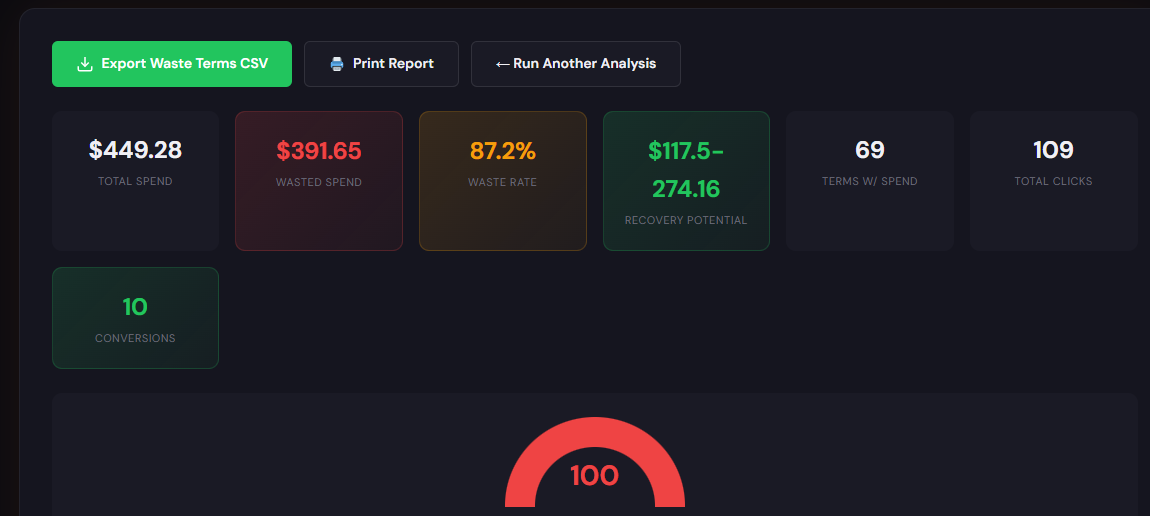
What it outputs: a dashboard-style snapshot listing total wasted spend, top leakage categories (search terms, placements, campaigns), and a prioritized recovery plan.
How to use it (3 steps)
- Run the snapshot against the last 30–90 days to get leakage by bucket.
- Export the recovery plan and apply the top 3 negative keyword and budget recommendations.
- Re-run after 7 days to measure recovered spend and iterate.
Search Term Analyzer (Bid Adjustment by Search Term)
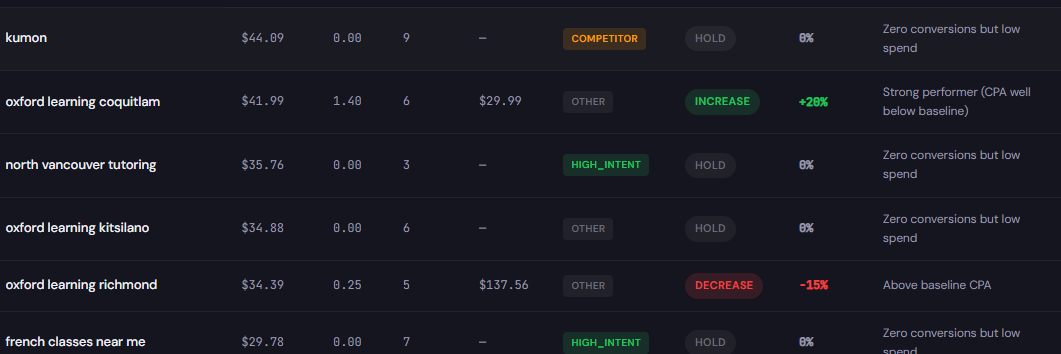
What it outputs: a prioritized table of search terms with spend, conversions, and suggested actions (negative, bid down, bid up, move to exact).
How to use it (3 steps)
- Upload keyword/search-term export; flag queries with cost and zero conversions.
- Apply suggested negatives and build a short-list of candidate exact-match moves.
- Create bid rules from the recommendation column for automation or manual adjustments.
90-minute account triage playbook
Run this script live with a teammate. The goal: identify 3 actions that recover budget and 2 that improve conversion signal within 90 minutes.
- 0–10 min: Open Wastage Snapshot to surface top 3 leakage areas.
- 10–30 min: Export search terms for the top leakage campaign; run Search Term Analyzer and add immediate negatives (apply the top 10 now).
- 30–50 min: Pull hour-of-day performance and set conservative bid modifiers for worst-performing hours (-20%) and best hours (+10%).
- 50–70 min: Segment any ad groups with >20 unrelated keywords; write 1 new ad per high-spend keyword with matched headline.
- 70–85 min: Validate primary conversion event and run a quick CRM match sample if available.
- 85–90 min: Document the three immediate actions, assign owners, and schedule a 7-day check-in.
Execute the triage playbook with ExecWrite’s Snapshot and Analyzer to recover budget quickly.
FAQ
If you act on high-impact negatives and hour bids, you can see immediate reduction in wasted clicks within 48–72 hours. True ROAS recovery may take 7–14 days as automation stabilizes.
Yes. Use the bid recommendations from the Search Term Analyzer and the hourly bid table as rules in your bidding system or apply them via scripts. Start conservatively and monitor.
The tools accept exported reports (search terms, performance by hour) — you don’t need account-level API access for quick audits. For continuous automation, connector options are available on ExecWrite.
Improving ad relevance and landing-page alignment typically reduces CPC and increases impression share. Fixes targeted at your top-spend keywords yield the fastest impact.
Leave a Reply