If your account is bleeding spend, your bids are misaligned, or conversions keep drifting, this post gives a repeatable, operator-level playbook. We reference tools and templates available at execwrite.com to speed audits and produce export-ready fixes.
- Most performance drops come from wasted spend, bid timing, and keyword-to-landing-page disconnects.
- Run a 90-minute triage: waste snapshot, search-term bid actions, and overnight quality-score fixes.
- Use two ExecWrite tools (Wastage Snapshot & Search Term Analyzer) to generate prioritized, exportable actions in minutes.
Table of Contents
Why PPC feels harder now
Three structural shifts make sustaining performance harder: higher baseline CPCs, heavier automation with opaque decisions, and more fragmented intent signals. Those trends mean small leaks compound quickly and automation can amplify errors instead of fixing them.
The 5 biggest PPC problems marketers face
1) Wasted spend hiding in long tail queries
Symptoms
- High spend on low-converting search terms.
- Many impressions but low conversion rate and rising CPA.
- Frequent month-to-month cost spikes tied to generic queries.
Why it happens
Broad match and aggressive keyword expansion without systematic negative lists let irrelevant traffic slip through. Automation can bid on those queries and accelerate waste.
Fix this week
- Export last 90 days of search term data and identify top spend/no-convert terms.
- Apply negative keywords at campaign or account level for repeated garbage queries.
- Move high-spend, low-convert queries into phrase/exact and test separate ad groups.
2) Bid timing and dayparting mismatch
Symptoms
- Hourly or daily CPA swings (weekends vs weekdays).
- Ad schedule set and ignored by Smart Bidding behavior.
- High-converting hours getting flat bids.
Why it happens
Most accounts never test hour-of-day adjustments after enabling automated bidding. Automated systems optimize broadly; they can miss consistent hour-specific patterns visible only in granular data.
Fix this week
- Pull hour-of-day performance for top campaigns and identify profitable windows.
- Apply ad schedule bid adjustments for the clear 2–4 hour windows where CPA/ROAS is best.
- Monitor for a week and re-open to granular bidding if automated bids revert.
3) Keyword-to-landing-page relevance and Quality Score leakage
Symptoms
- Declining CTR despite similar traffic levels.
- High impression share but poor conversion rates.
- Ad relevance or landing page warnings in account diagnostics.
Why it happens
Ads, keywords, and landing pages drift apart as campaigns scale. Small headline or messaging mismatches degrade Quality Score and increase CPCs across the board.
Fix this week
- Scan top ad groups for headline-to-landing-page mismatches and prioritize 10 groups for urgent fixes.
- Update headlines and one landing page element (H1 or CTA) for each group; measure CTR and conversion change.
- Use a small A/B test to validate which headline-landings restore performance.
4) Poor account structure and orphaned ad groups
Symptoms
- Large ad groups with mixed intent keywords.
- Multiple ads in a group showing wildly different CTRs and conversion rates.
- High internal search term duplication and overlap.
Why it happens
Ad-hoc additions, rushed expansions, and agency handoffs create structural entropy. Over time, it becomes hard to diagnose which element is causing a drop in KPIs.
Fix this week
- Identify ad groups with CTR or CVR in the bottom 10% and move their high-intent keywords into new focused groups.
- Standardize naming and add intent tags to ad groups to simplify future audits.
- Export to Google Ads Editor for bulk structural fixes.
5) Automation amplified errors (bids, budgets, creatives)
Symptoms
- Rapid spend increases without corresponding conversions.
- Sudden traffic drops after algorithm updates.
- Conflicting automated rules and bidding strategies.
Why it happens
Automation is powerful, but when inputs (audience lists, conversion values, tracking) are wrong, algorithms optimize the wrong outcome and scale errors.
Fix this week
- Pause aggressive portfolio bidding or rules on one affected campaign and compare performance.
- Verify conversion tracking and conversion value mapping for your top 5 campaigns.
- Set temporary conservative bid caps and monitor the algorithm response.
Fixes you can apply this week
- Run a quick wastage audit and produce a prioritized negative-keyword list.
- Extract hour-of-day performance and apply targeted ad schedule adjustments.
- Patch the worst 10 ad group landing-page mismatches (headlines + CTAs).
- Split the top 5 over-broad ad groups into tighter intent-based groups.
- Temporarily cap bids or pause portfolio strategies on one test set.
Use ExecWrite tools to create export-ready negative lists and bid actions, not spreadsheets you have to reformat.
Tool-based workflow: map problems to two ExecWrite tools
We focus on two high-impact tools you can run today. Each produces outputs you can export to Google Ads Editor or upload as negatives/bid adjustments.
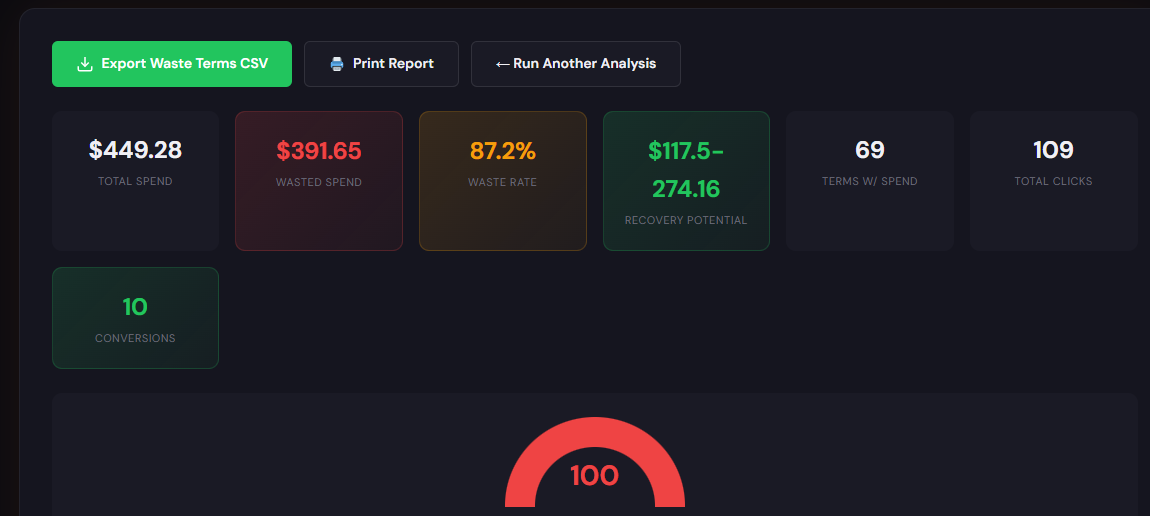
Wastage Snapshot & Recovery
What it outputs: Dashboard-style waste totals, top leakage areas, prioritized negative keyword and budget-reallocation recommendations.
How to use it (3 steps)
- Upload your account spend and search-term export to the Wastage Snapshot tool at ExecWrite Wastage Snapshot.
- Review the prioritized recovery plan—negative keywords, budget shifts, and quick pause candidates.
- Export the negative keyword list and action CSVs; apply via Google Ads Editor or automations.
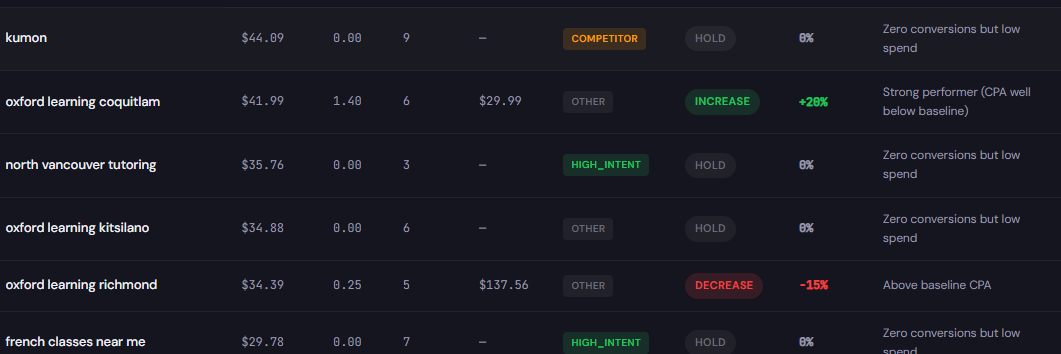
Bid Adjustment by Search Term (Search Term Analyzer)
What it outputs: Line-item search term table with spend, conversions, CPA, and recommended bid adjustments by term. Includes hourly or daypart recommendations if you use the Hourly Bid Adjuster.
How to use it (3 steps)
- Run the Search Term Analyzer at ExecWrite Search Term Analyzer with your recent search term export.
- Filter by spend and CPA thresholds to accept/flag suggested bid actions; use the included tags for immediate negatives.
- Export the bid-adjustment CSV and upload to Google Ads Editor or apply as ad schedule changes if the tool flags hour-of-day patterns.
90-minute account triage playbook
- 0–15: Pull data — last 30–90 days search terms, hourly performance, top campaign spend, and conversion mapping.
- 15–35: Run the Wastage Snapshot and identify top 20 negative keyword candidates and top 3 leak campaigns.
- 35–55: Run the Search Term Analyzer for the same window; export recommended bid actions and tag top spend/no-convert terms.
- 55–70: Apply urgent negatives and conservative bid caps to the worst campaigns. Schedule ad schedule adjustments for obvious hour winners.
- 70–90: Document actions, upload CSVs to Google Ads Editor, and set a 7-day monitoring check with alerts for CPA drift.
Run the Wastage Snapshot and Search Term Analyzer to get prioritized, actionable outputs that go straight into Google Ads Editor.
FAQ
You should see immediate reductions in irrelevant clicks—measure over 7 days to avoid overfitting and inadvertently removing intent.
Use them as directional inputs. Validate by applying small test adjustments and measuring the algorithm response for 3–7 days.
No—most workflows use exported reports (search terms, hourly performance). Exports are plugged into the tools to produce action lists.
Yes—tightening ad group relevance and aligning headlines to landing pages typically improves CTR and quality score within 2–4 weeks.
Leave a Reply