If your account is burning budget without reliable conversions, this piece gives a short, repeatable playbook to stop leakage and recover ROI. Use the checklist and the linked ExecWrite tools to audit, action, and automate immediate wins.
- Most wasted spend comes from irrelevant search terms, poor bid timing, and ad/landing-page mismatch.
- Run a structured 90-minute triage, triage waste with an automated snapshot, and apply hourly bid adjustments for dayparting swings.
- Use the ExecWrite Wastage Snapshot + the Search Term Analyzer to find negative-keyword opportunities and smart bid actions fast.
Table of Contents
Why PPC feels harder now
PPC performance is more volatile: auction dynamics change fast, automation changes bid behavior, and data privacy makes attribution noisy. That means manual rules that used to work are now brittle—and time-of-day, search-term relevance, and landing-page fit matter more than ever.
If you want a fast, repeatable way to arrest waste, you need both a focused manual checklist and tools that turn noisy reports into action items.
The 5 biggest PPC problems marketers face
1) Hidden waste in search terms
Spent clicks that look fine at keyword level but deliver irrelevant user intent.
Symptoms
- High spend with low conversion rate on broad/phrase match terms.
- Search terms report shows off-topic queries.
- Conversions concentrated in a few specific queries while most traffic converts poorly.
Why it happens
Broad match behavior and smart bidding can harvest lots of impressions from low-intent queries. Without a fast way to parse the search-terms report, negative keywords and bid adjustments lag behind the damage.
Fix this week
- Export the last 30 days of search terms and sort by spend then CPA.
- Tag or flag irrelevant queries and add as negatives in bulk.
- Pause keyword variants that consistently trigger poor queries until you map intent.
2) Wasted spend from poor campaign structure and overlap
Duplicate intent spread across campaigns/ad groups amplifies bid conflicts and drives up cost.
Symptoms
- Multiple ad groups competing for the same queries.
- Frequent rank flipping between similar ads/keywords.
- High impression share loss despite healthy budgets.
Why it happens
Loose keyword structure and overlapping match types cause auctions to internal-bid against yourself. That inflates CPCs and hides which creative or landing page actually drives conversions.
Fix this week
- Consolidate overlapping keywords into single-ad-group themes.
- Use single-keyword ad groups for high-value terms to control messaging.
- Apply negative exacts across sibling groups to prevent cannibalization.
3) Time-of-day and dayparting drains efficiency
CPA and conversion rates swing by hour and platform; default bidding ignores fine-grained patterns.
Symptoms
- CPA spikes during specific hours with similar traffic volume.
- Conversion rate drops at night or weekends.
- High spend during low-converting hours.
Why it happens
Automation averages bids across time windows. If you have distinct business hours or user behaviors, you need targeted ad schedule adjustments and hour-level bids to control spend.
Fix this week
- Run an hour-of-day performance report (cost, conv, CPA) for 30 days.
- Apply -20% to -50% bid adjustments for hours with double the CPA; increase for peak hours that convert well.
- Test an ad schedule that blocks low-converting windows for a week and measure delta.
4) Ad copy and landing-page mismatch (Quality Score leaks)
Low ad relevance and landing-page alignment push CPCs up and lower conversion rates.
Symptoms
- Low click-through rates versus industry benchmarks.
- High bounce rate on paid landing pages.
- Quality Score lower than peers for core terms.
Why it happens
Signal mismatch between search intent, ad creative, and landing-page content reduces ad rank efficiency. Small headline or CTA misalignment can compound across volume.
Fix this week
- Align top 10 converting queries to ad headlines and landing page H1s.
- Create a short A/B test: headline + CTA variant vs control for 1–2 weeks.
- Add query-specific extensions (callouts, sitelinks) to improve CTR.
5) Measurement gaps hide real ROI
Missing offline conversions, cross-device noise, or incorrect goals distort smart bidding signals.
Symptoms
- Conversions fall but leads or revenue remain steady (or vice versa).
- Smart bidding recommendations swing wildly after a few conversions.
- Attribution models show inconsistent channel credit.
Why it happens
Incomplete conversion feeds and attribution mismatches feed bad data into automated bid strategies. The result: bid models optimize for the wrong outcomes.
Fix this week
- Audit conversion tags and ensure onsite events map to business outcomes.
- Upload offline conversions if applicable and align conversion windows.
- Temporarily cap automated bidding until conversion volume stabilizes.
Fixes you can apply this week
- Run a search-terms export and add negatives for irrelevant queries (30 minutes).
- Run a wastage snapshot to prioritize leaks by spend and recovery opportunity (15–30 minutes).
- Apply hour-of-day bid adjustments based on current CPA swings (20–40 minutes).
- Sync top-performing queries to landing-page headlines; launch one A/B test (60 minutes prep).
- Freeze risky automation rules and monitor performance daily for 7 days.
Use an automated wastage snapshot to find the top spend leaks and negative keyword opportunities in minutes.
Tool-based workflow: map the pain points to ExecWrite tools
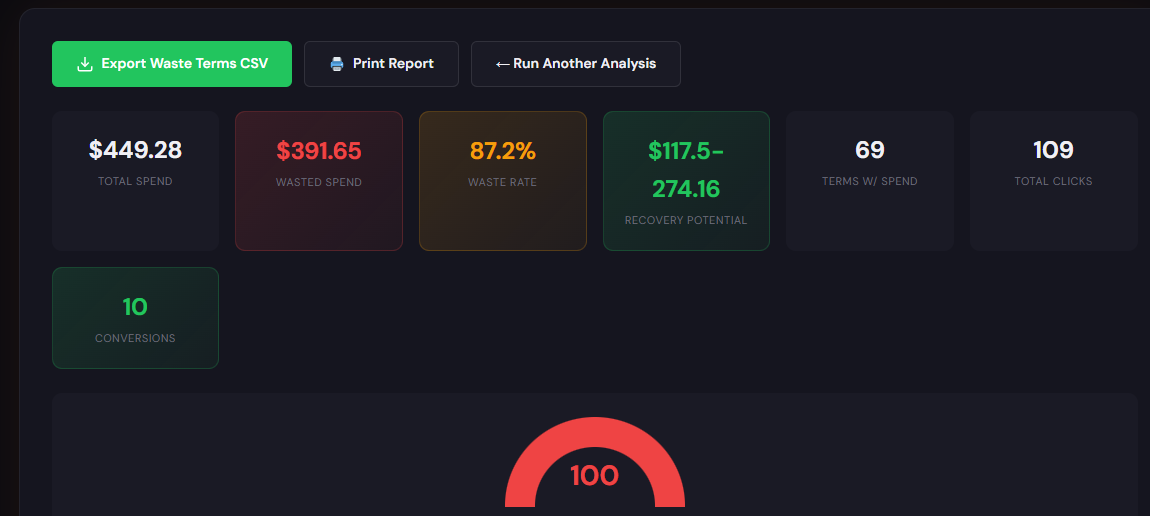
What it outputs
- Top leakage buckets (search terms, budgets, campaign overlap) with dollar estimates.
- Negative keyword and budget recommendations prioritized by recovery value.
- Quick recovery plan you can action in bulk.
How to use it in 3 steps
- Upload or connect the account data and run the snapshot (5–15 minutes).
- Review top leak categories and export the negative-keyword list.
- Apply recommendations: add negatives, reassign budgets, and re-run after 7 days.
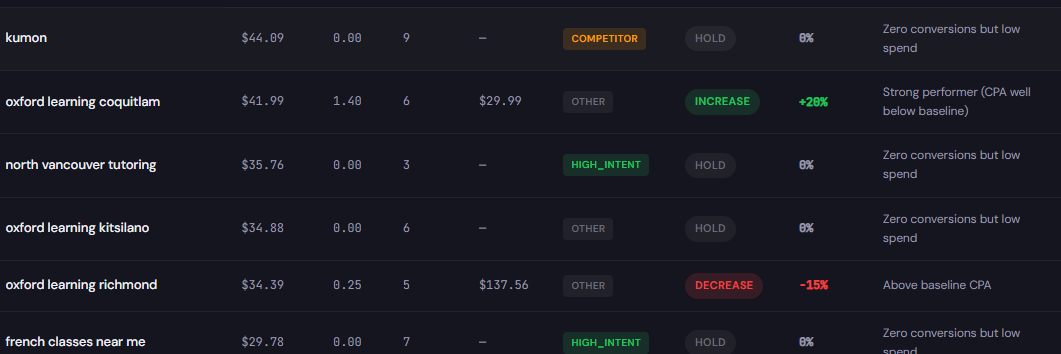
What it outputs
- Search-term-level rows with spend, convs, CPA, and recommended bid actions (raise/lower/negate).
- Grouped intent tags and easy CSV export for bulk updates.
- Hour-of-day aggregated insights when combined with hourly bid tool.
How to use it in 3 steps
- Load the search-terms export or connect your account and let the analyzer tag intents.
- Filter top spend/low-conversion queries, mark as negatives or set bid adjustment actions.
- Export and upload changes or push via bulk updates into Google Ads Editor for quick deployment.
90-minute account triage playbook
- 0–10 min: Snapshot—Run the ExecWrite Wastage Snapshot and download the top leakage summary.
- 10–30 min: Search-terms—Load the top 500 search terms into the Search Term Analyzer; tag and flag negatives.
- 30–50 min: Apply quick fixes—Add top negatives, pause non-converting high-spend keywords, and consolidate overlapping ad groups.
- 50–70 min: Dayparting—Run hour-of-day report; apply bid adjustments for worst-performing windows.
- 70–85 min: Landing page—Sync top 10 converting queries to headlines; launch one landing-page variant if time.
- 85–90 min: Monitor—Set alerts for CPA and conversion drops; schedule a 7-day follow-up snapshot.
Use ExecWrite tools to generate negative-keyword lists, bid-action CSVs, and a recovery plan you can deploy the same day.
FAQ
No. A focused 90-minute triage using a wastage snapshot and search-term analysis will catch the highest-impact leaks and buy you breathing room to plan deeper fixes.
Run a quick snapshot weekly for high-spend accounts, and at minimum monthly for smaller accounts. Re-run after any major creative or automation change.
Good negatives remove irrelevant impressions and improve efficiency. Start conservative (high-spend, low-conversion queries) and measure impact for a week before broad blocking.
Automation helps but relies on clean conversion signals. Use automated tools for monitoring and exports, but pair them with human triage for intent judgments and structural fixes.
Leave a Reply