If clicks are rising and results are falling, you need a fast, evidence-first triage—not another theory. Use the checks and the tool-based workflows below to find waste, fix structure, and recover budget. For hands-on tools, see ExecWrite at execwrite.com for automated snapshots and search-term analysis.
- Most underperforming accounts show the same symptoms: wasted spend, poor structure, tracking gaps, and creative mismatch.
- Apply a 7-step weekly checklist and a 90-minute triage to stop leakage and recover budget fast.
- Use targeted tools — a wastage snapshot and a search-term analyzer — to prioritize fixes and automate low-effort wins.
Table of Contents
Why PPC feels harder now
Three structural shifts make PPC harder: increased automation in bidding and targeting, higher CPCs in competitive verticals, and measurement drift due to privacy and attribution changes. Those shifts amplify ordinary account problems and hide them inside automation. You need fast diagnostics and surgically precise fixes—manual tweaks plus tool-assisted audits—to get stable performance again.
The 5 biggest PPC problems marketers face
Pain 1 — Wasted spend on poor queries
Symptoms
- High impressions and clicks but low conversions from specific search terms.
- High CPA in broad-match campaigns; many low-intent queries in search term reports.
- Frequent spend on irrelevant modifiers or competitor names.
Why it happens
Broad match + automated bidding can surface irrelevant queries that still get credit for conversions at account level, hiding the underlying waste. If you don’t audit search terms and add negatives, automation will buy the bad traffic.
Fix this week
- Export last 30 days of Search Terms; tag irrelevant terms and add negatives immediately.
- Pause broad-match keywords with poor intent and move high-performing terms into exact/ad-group-level control.
- Use your Search Term Analyzer to generate bid actions and negative lists (fast win).
Pain 2 — Conversion tracking and attribution gaps
Symptoms
- Sudden drops or spikes in conversions not explained by landing pages or bids.
- Discrepancies between GA4 and Google Ads conversions.
- High-traffic campaigns with zero offline or cross-channel attribution.
Why it happens
Tracking breakage, misconfigured events, and inconsistent attribution windows create blind spots. Automation optimizers act on flawed signals, amplifying the wrong behaviors.
Fix this week
- Run a conversion sanity check: compare last 7/30/90 days across systems and flag >15% divergence.
- Verify event tagging and conversion windows; switch to server-side where possible.
- Map offline conversions and import them to Google Ads or adjust bids accordingly.
Pain 3 — Ad-to-landing-page mismatch (Quality Score leaks)
Symptoms
- CTR and conversion rate drop after ad copy changes or landing page updates.
- Low Quality Score on keywords with otherwise relevant intent.
- High bounce rate from paid traffic.
Why it happens
When creative and landing pages drift from the keywords that triggered the ad, Google reduces ad rank or inflates CPCs. Small message mismatches multiply across automated bidding.
Fix this week
- Audit top 10 ad groups by spend and align headlines with landing page headlines.
- Test one ad and one landing page variant per week for priority groups.
- Use a Quality Score diagnostic to get headline and landing-page suggestions.
Pain 4 — Dayparting and bid timing inefficiencies
Symptoms
- Large ROI swings by hour of day; winning hours are underbid.
- Uniform ad schedule despite clear business hour performance patterns.
Why it happens
Many accounts inherit a default ad schedule and leave automated bidding to smooth performance. That misses predictable hourly peaks and valleys where manual hour-of-day adjustments capture higher ROI.
Fix this week
- Review hourly performance for the last 30 days and identify top/bottom 3 hours.
- Apply conservative hour-of-day bid adjustments (+20%/-20%) and monitor 72 hours.
- Use an hourly bid adjuster to generate data-backed recommendations.
Pain 5 — Account structure and keyword hygiene
Symptoms
- Single campaigns with hundreds of keywords and mixed intent.
- Low relevance across ad groups; reporting is noisy and slow to act on.
Why it happens
Poor structure reduces signal and forces automation to guess. You need tighter ad groups, intent-based keywords, and better naming conventions to get reliable performance.
Fix this week
- Split the top-spend campaign into focused ad groups by intent (commercial, navigational, informational).
- Create negative lists at campaign level to stop cross-intent cannibalization.
- Use automated campaign templates to export a campaign structure you can iterate on fast.
Fixes you can apply this week
- Export search-terms, tag negatives, and add them to campaign-level negative lists (day 1).
- Sanity-check conversions and align windows across reporting platforms (day 1–2).
- Isolate top 3 spend ad groups and align ads to landing pages; run one A/B test (day 3–7).
- Apply conservative hour-of-day bid adjustments and monitor for 72–96 hours.
- Document all changes in a shared sheet and measure lift vs a control week.
Get a dashboard that flags leakage areas, negative keyword opportunities, and a recovery plan you can action in hours.
Tool-based workflow — map pain to ExecWrite tools
We focus on two tools that deliver fast, prioritized outputs: a Wastage Snapshot & Recovery and the Search Term Analyzer. Use them together for diagnosis + surgical fixes.
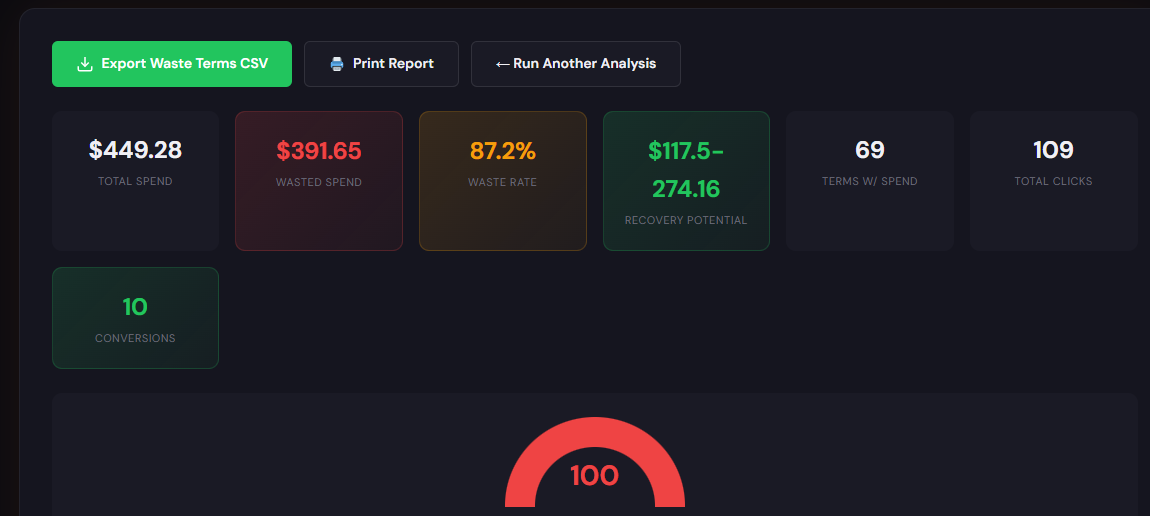
What it outputs
- Top leakage categories (search terms, devices, campaigns).
- Prioritized recovery checklist with estimated monthly savings.
- CSV exports for negative keyword implementation and paused items.
How to use it — 3 steps
- Upload your account CSV or connect via Google Ads and run the snapshot (tool).
- Review the top 5 leakage items, export the negative list and recovery actions.
- Implement negatives and pause low-probability spend; re-run snapshot after 7 days to measure savings.
Preview: dashboard-style snapshot with recovery plan and leakage totals.
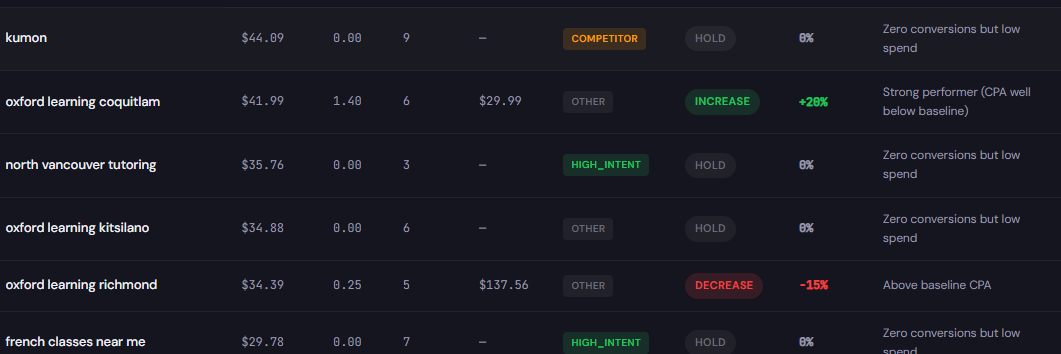
What it outputs
- Tagged search-term table with spend, conversions, and recommended bid actions.
- Automated negative keyword lists and suggested bid adjustments by term.
- Export-ready lists to paste into Google Ads Editor.
How to use it — 3 steps
- Export your Search Terms report from Google Ads and upload it to the analyzer (tool).
- Review tags (irrelevant, long-tail, brand) and accept suggested negatives and bid overrides.
- Export CSV for Google Ads Editor and apply changes in a controlled rollout.
Preview: table showing spend, conversions, tags, and recommended actions for quick implementation.
Both tools together: run the wastage snapshot to find the biggest leaks, then use the search term analyzer to implement the quick negative fixes and bid adjustments. This two-tool approach isolates waste and converts it into recovered budget.
90-minute account triage playbook
Use this time-boxed checklist when an account is underperforming and you need fast wins.
- 0–10 min: Open the account and check top-level KPIs (cost, convs, CPA, conv rate). Note any >20% deviation vs last 7 days.
- 10–25 min: Export Search Terms (30 days) and run a quick filter for irrelevant queries. Add immediate campaign-level negatives for obvious waste.
- 25–40 min: Run a conversion sanity check—compare Google Ads to analytics or CRM. Flag events that stopped firing.
- 40–55 min: Run a Wastage Snapshot to get prioritized leakage areas and a recovery plan (export results).
- 55–75 min: Use the Search Term Analyzer on the same export to produce a negative list and bid actions. Export CSV for Google Ads Editor.
- 75–90 min: Implement the top 5 changes (negatives, pause top waste campaign, apply conservative bid adjustments). Document changes and schedule a 72-hour check.
Run a snapshot and search-term analysis to convert wasted spend into measurable savings. Fast, export-ready outputs you can implement in hours.
FAQ
Answers
Expect measurable changes in 48–72 hours. Negative keywords stop new low-intent traffic immediately, but automated bid systems may need a few days to stabilize.
Answers
Yes. Automation relies on signal quality. Clearing low-quality queries and fixing conversions gives automated bidding better inputs—so the fixes compound over 1–2 weeks.
Answers
Watch CPA and conversion rate by priority campaign. If CPA is rising and conv rate is falling, trace back to search terms and tracking to find the root cause.
Answers
Yes—apply changes conservatively, document them, and use staged rollouts. Tools that produce exports for Google Ads Editor make staged implementation safer and repeatable.
Leave a Reply