If your account feels like it’s bleeding budget with poor results, this guide cuts through the noise. We show a focused 90-minute triage, quick fixes you can apply this week, and two ExecWrite tools that turn audit findings into action. Try the tools at ExecWrite to accelerate recovery.
- Wasted spend and bid mismatches are the most common immediate drag on PPC performance.
- Apply the 90-minute triage and five checklist fixes this week to stop leakage and improve CPA/ROAS.
- Use the Wastage Snapshot and Search Term Analyzer at ExecWrite to generate recovery actions in minutes.
Table of Contents
Why PPC feels harder now
Fewer guaranteed wins, more automation, and noisier signals make manual optimizations less effective unless they’re surgical. Marketers face three structural shifts:
- Automated bidding reduces low-effort wins—manual fixes must be precise.
- Search behavior fragments; more irrelevant queries slip through.
- Measurement gaps hide where spend fails to drive conversions.
These changes mean a generic optimization plan fails. You need fast triage, search-term accuracy, and targeted bid adjustments.
The 5 biggest PPC problems marketers face
1) Wasted spend and budget leakage
Symptoms
- High spend on low or zero-converting campaigns.
- High CPA in campaigns that historically converted.
- Large spend on irrelevant search terms.
Why it happens
Accounts accumulate irrelevant query traffic, overlapping keywords, and runaway automated bids. Unless audited, the leaks compound across campaigns and budgets.
Fix this week
- Run a top-10 spend search-term report for last 30 days.
- Pause or add negatives for clearly irrelevant queries.
- Reallocate budget from high-cost low-converting campaigns to proven performers.
2) Search-term mismatch (keyword vs intent)
Symptoms
- High impressions/clicks but low conversion rate on specific queries.
- Broad-match expansions driving low-quality traffic.
- Ad copy mismatch for high-cost queries.
Why it happens
Match types and automation can surface tangential or research-phase queries. If ad copy and landing pages don’t match intent, quality and conversion rates drop.
Fix this week
- Tag converting vs. non-converting queries and move non-converting queries to negative lists.
- Create tight phrase/exact ad groups for high-intent queries with tailored ads.
- Test ad copy that mirrors the top-performing query language.
3) Poor Quality Score and landing page mismatch
Symptoms
- Low expected click-through rate or low ad relevance warnings.
- High CPC despite average bids.
- Landing page bounce rises when traffic volume peaks.
Why it happens
Quality Score is driven by ad relevance, expected CTR, and landing page experience. Messaging or page experience that drifts from your ads will increase CPC and reduce conversions.
Fix this week
- Compare top ad headlines to landing page H1 and main CTA—align them.
- Fix slow pages and remove autoplay media that hurt experience.
- Run a small A/B test: original vs headline-aligned landing page.
4) Bid timing and dayparting mistakes
Symptoms
- Sharp hourly swings in CPA or ROAS.
- Ad schedule not reflecting conversion hours.
- High spend during low-conversion periods.
Why it happens
Automated bidding and static schedules don’t always capture hourly conversion windows. Without hourly analysis, you bid into poor windows and miss peak hours.
Fix this week
- Pull hour-of-day performance and spot hours with CPA 20%+ above average.
- Set bid modifiers (or schedule reductions) for poor hours; boost for peak hours.
- Monitor for 3-7 days and iterate.
5) Tracking and attribution blindspots
Symptoms
- Conversion counts drop after tagging or site changes.
- High click volumes with unexplained conversion variance.
- Server-side tagging or cross-domain issues create gaps.
Why it happens
Tracking setups degrade when pages change, tags break, or conversions move off-site. Incomplete data leads to bad optimization decisions.
Fix this week
- Validate primary conversion actions in Google Ads and GA4 for the last 30 days.
- Run test conversions from multiple devices and browsers.
- Flag any discrepancies >10% for engineering to fix.
Fixes you can apply this week
- Export top search terms by spend and tag them: convert / irrelevant / research.
- Apply negatives at the campaign or shared-list level for irrelevant tags.
- Make three headline-to-landing-page alignment edits for your top-converting ad groups.
- Reduce bids by 10–20% during identified low-performing hours and increase during peaks.
- Run a quick tracking validation: test conversions, compare to server logs, and document gaps.
Use ExecWrite’s Wastage Snapshot to find leakage, negative keyword priorities, and a recovery plan in minutes.
Tool-based workflow: map pain points to two ExecWrite tools
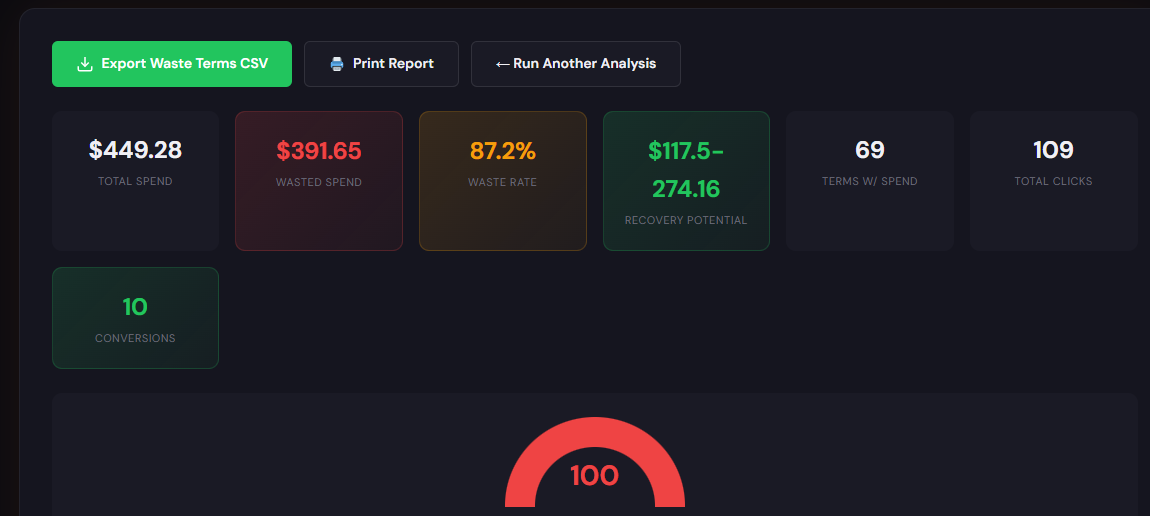
What it outputs
- Dashboard showing total wasted spend, top leakage areas, and prioritized recovery actions.
- Negative keyword suggestions and quick campaign reallocations.
- A one-page recovery plan you can hand to stakeholders.
How to use it in 3 steps
- Upload your last 30–90 days of Google Ads data to generate the snapshot.
- Review the top leakage areas and apply the suggested negatives directly to your account or export them.
- Run the recovery plan actions (pause high-leak campaigns, reallocate budget, align landing pages) and monitor 7-day performance delta.
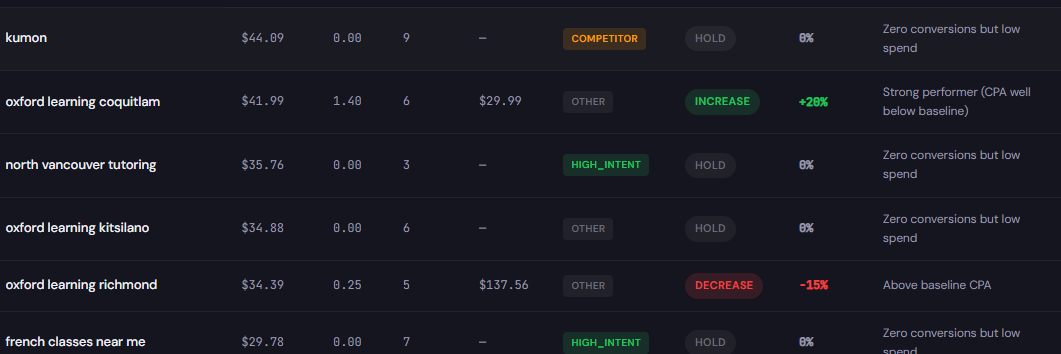
What it outputs
- Search-term-level table with spend, conversions, CPA, and recommended bid actions.
- Tags for quick segmentation: convert / research / negative.
- CSV or Google Ads Editor-ready bid adjustment recommendations.
How to use it in 3 steps
- Paste your search term report into the analyzer or connect via upload.
- Review terms flagged as high-spend/low-conversion and accept recommended negative or bid changes.
- Export the bid adjustments and import via Google Ads Editor or apply shared negatives.
Map: use Wastage Snapshot first to find overall leaks, then run the Search Term Analyzer on the priority campaigns to generate exact bid and negative actions.
90-minute account triage playbook
- Minutes 0–10: Data grab — Export last 30 days: search terms by spend, campaign performance, hourly performance, and conversion metrics.
- Minutes 10–25: Wastage quick scan — Load top spend campaigns into the Wastage Snapshot to highlight top leakage areas.
- Minutes 25–45: Search term triage — Paste the top spend search-term report into the Search Term Analyzer. Tag top negatives and high-cost low-converting queries.
- Minutes 45–60: Tactical fixes — Apply negative lists, pause or reduce budgets on leaking campaigns, and push urgent bid schedule changes for worst hours.
- Minutes 60–75: Landing page alignment — For top 3 converting ad groups, align headline, CTA, and main H1 with ad copy; note pages for A/B tests.
- Minutes 75–90: Tracking check and handoff — Validate key conversions, record discrepancies, and create an action list for engineering if needed.
This playbook surfaces the biggest wins: negatives, bid schedule adjustments, and landing page fixes—actions that stop waste and improve signal for automated bidding.
Use both tools together to generate prioritized fixes and an export-ready recovery plan.
FAQ
Expect measurable CPA/ROAS improvement within 7–14 days after applying negatives, reallocating budget, and fixing dayparting. Search-term and schedule changes produce the fastest delta; landing page tests take longer.
Yes. You can upload export files (search-term reports, campaign performance) into ExecWrite tools; account access is not required for the initial audit workflow.
Applying negative keywords and stopping the top 3 leak campaigns typically yields the largest immediate ROI by eliminating wasted spend.
No. These tools improve the inputs and data quality that automated bidding relies on: better negatives, corrected bids for hours, and landing-page alignment. Automation performs better with cleaner signals.
Sources
- Google Ads: About Quality Score — Official overview of how ad relevance and landing pages affect quality score.
- Google Ads: Ad schedule and conversion metrics — Google guidance on dayparting and scheduling bid adjustments.
- WordStream: How to Reduce Wasted Ad Spend — Practical tactics for negative keywords and budget reallocation.
Leave a Reply