If clicks aren’t converting and costs are rising, you need a repeatable triage process—not guesses. This post shows exactly where accounts leak, what to change this week, and how to use ExecWrite tools to recover wasted budget fast. Try the tools at execwrite.com for diagnostics and automated fixes.
- Most performance drops come from wasted spend: low-intent keywords, wrong times-of-day, weak ad-to-page relevance, and noisy conversion data.
- Run a 90-minute triage to find the top 20% of leaks that cause 80% of waste, then apply simple bid, negative keyword, and landing-page fixes.
- Use ExecWrite tools (Wastage Snapshot & Search Term Analyzer) to pinpoint leakage, recover budget, and generate bid actions in minutes.
Table of Contents
Why PPC feels harder now
Paid media is more competitive and automated, which raises the bar for data hygiene, match-type control, and relevance. Smart bidding masks poor signal; automated budgets amplify waste. If your account hasn’t tightened keyword intent, ad relevance, and conversion tracking, automation will optimize the wrong objective faster.
The 5 biggest PPC problems marketers face
1) Wasted spend from low-intent queries
Symptoms
- High click volume with near-zero conversions from specific search terms.
- Low conversion rate but steady impressions from broad/phrase matches.
- High cost per conversion in campaigns with wide match types.
Why it happens
Match types, broad keyword strategies, and missing negative keywords let low-intent queries drain budget. Automated bidding compounds the damage by bidding on signals that aren’t tied to true intent.
Fix this week
- Download the top 1,000 search terms; tag low-intent ones (info, research, unrelated).
- Implement negatives at campaign & account levels for the worst offenders.
- Limit broad match or move high-cost volumes into exact/phrase with tighter bids.
2) Poor ad-to-landing-page relevance (Quality Score leakage)
Symptoms
- High CPCs despite strong bids; low CTR and poor landing conversion rates.
- Large gaps between ad headlines and landing page messaging.
Why it happens
Teams often reuse creative across products or rely on generic landing pages. Quality Score and conversion rates drop when messaging, offer, and CTAs aren’t aligned with the user’s query.
Fix this week
- Group top-performing queries by intent and create 1:1 ad-to-page pairs for the highest-spend groups.
- Change headlines to match the query intent and add a clear, consistent CTA on the landing page.
- Run an A/B test for pages with large impression share and low conversion rates.
3) Wrong time-of-day or dayparting bids
Symptoms
- Sharp hourly swings in CPA/ROAS that align with time of day.
- Campaigns performing well overall but losing money during specific hours.
Why it happens
Default ad schedules and broad bid strategies ignore hour-level performance. Without dayparting, campaigns bid the same at low-converting hours as they do at peak hours.
Fix this week
- Pull performance by hour for the past 30 days; mark the worst and best performing hours.
- Apply -20% to -50% adjustments on low-performing hours and +10% to +30% on peaks.
- Re-check after 7 days and iterate on the adjustments.
4) Noisy or missing conversion tracking
Symptoms
- Conversion spikes that don’t match sales data or CRM.
- High volume of leads with zero value or refunded purchases.
Why it happens
Tracking fires for soft conversions, duplicate events, or test submissions. Smart bidding optimizes to these noisy signals and allocates spend away from true revenue drivers.
Fix this week
- Audit tag manager and GA/GA4 events; disable duplicates and low-value events from bidding.
- Switch bidding to target ROAS/CPA only after cleaning conversion goals.
- Set up a value-based feed or import CRM revenue to align bids with real outcomes.
5) Fragmented account structure and poor SKAG hygiene
Symptoms
- Many overlapping keywords and duplicated ad copy across ad groups.
- Confused auction behavior and inconsistent QS across similar keywords.
Why it happens
Growth without governance creates overlapping keyword coverage and internal competition. That wastes impressions and bids, making optimization noisy.
Fix this week
- Merge duplicate keywords and move high-volume queries into tightly themed ad groups.
- Apply single-focus ad copy per ad group to improve CTR and QS.
- Use negative keywords to eliminate internal keyword cannibalization.
Fixes you can apply this week
- Run a search-term export and tag the top 200 low-intent queries; create negatives.
- Identify top 20% spend buckets causing 80% of waste; pause or lower bids immediately.
- Match ad headlines to query intent for top 10 ad groups; update landing pages on those groups.
- Pull hourly performance and apply temporary daypart bid adjustments.
- Audit conversion events: remove duplicates, and mark low-value events as ‘not for bidding’.
Use ExecWrite’s Wastage Snapshot to find budget leaks, negative keyword candidates, and a prioritized recovery plan in minutes.
Tool-based workflow: map problems to ExecWrite tools
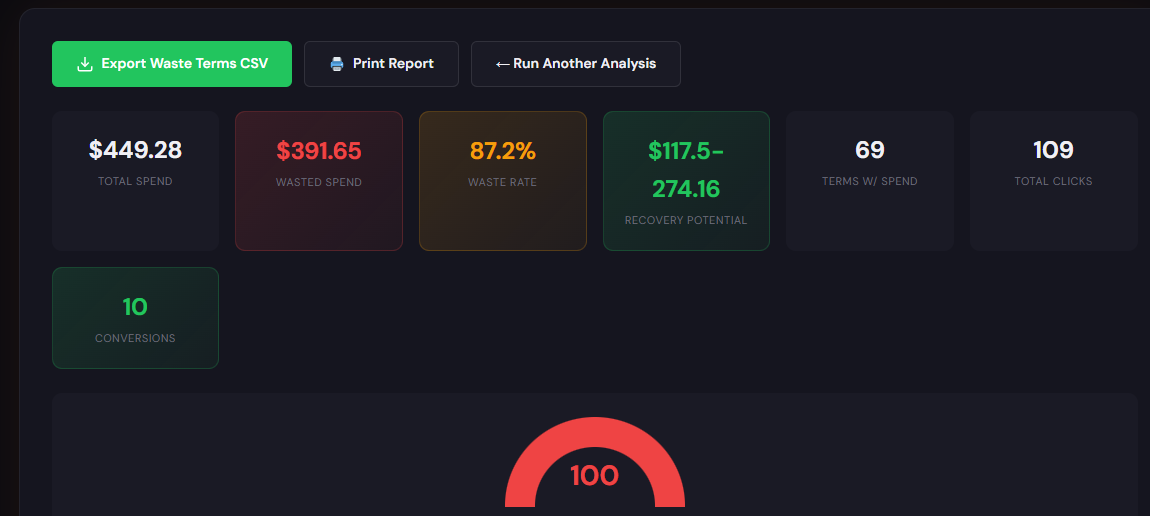
What it outputs: a dashboard-style snapshot showing total wasted spend, top leakage categories (search terms, keywords, campaigns), and a prioritized recovery plan with suggested negatives and budget shifts.
How to use it in 3 steps:
- Upload or connect your account data and run the snapshot to surface the largest sources of waste.
- Review the top 10 negative keyword candidates and the recommended campaign pauses; accept or edit the suggestions.
- Apply the recovery plan and re-run in 7 days to confirm recovered budget and improved CPA.
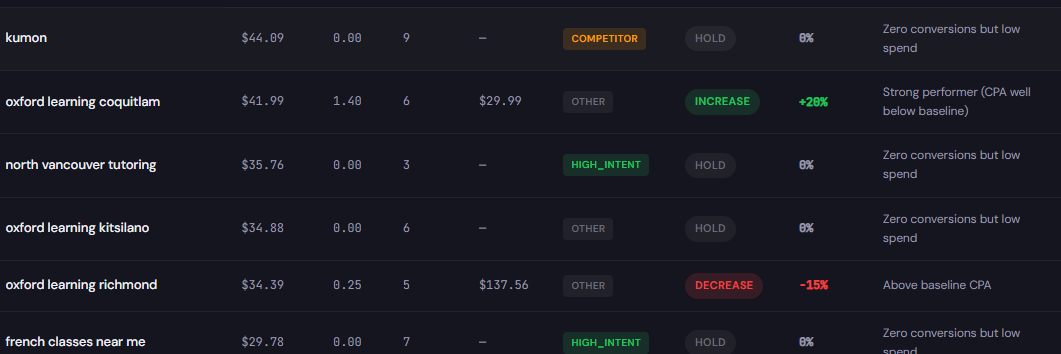
What it outputs: a table of search terms with spend, conversions, intent tags, and recommended bid actions or negative keyword status.
How to use it in 3 steps:
- Load recent search term data; the tool auto-tags intent (high, medium, low) and flags negatives.
- Approve negative tags and export a campaign-level negatives list or apply bid adjustments directly.
- Monitor the impact on CPA over the next 7–14 days and refine tags/rules as needed.
Both tools are fast to run and give action items you can apply without waiting for long experiments. Use the Snapshot to prioritize and the Analyzer to implement surgical fixes.
90-minute account triage playbook
- 0–10 min: Scope — identify top 3 campaigns by spend last 30 days.
- 10–30 min: Run Wastage Snapshot; export top leakage areas and the recovery checklist.
- 30–50 min: Run Search Term Analyzer on the same campaigns; mark negatives and high-cost low-intent terms.
- 50–70 min: Apply immediate actions — add negatives, reduce bids on worst hours, pause non-performing ad groups.
- 70–90 min: Create a short follow-up plan — what to recheck in 7 and 30 days; schedule landing-page updates for top groups.
- Outcome: a prioritized list of actions that typically recovers 20–40% of wasted spend in the next billing period.
Run the Wastage Snapshot and Search Term Analyzer to produce the 90-minute triage outputs automatically.
FAQ
Most accounts show CTR and CPC improvements within 7 days; meaningful CPA improvements usually show by day 14 as Smart Bidding adapts to cleaner signals.
Automation can adapt, which is why you must clean conversion signals and apply structural fixes first. Once the signal is clean, automation yields better results.
Removing high-spend, low-intent search terms and applying targeted negative keywords typically delivers the fastest ROI.
No; the tools are built for marketers. Wastage Snapshot and the Search Term Analyzer provide exportable action lists and negatives you can apply or pass to an ops teammate.
Sources
- Google Ads: About Smart Bidding — how automation uses conversion signals.
- WordStream: Common PPC Wastes and How to Fix Them — practical categories of wasted spend.
- Search Engine Land: Why Quality Score matters — relevance and QS impact on CPC and visibility.
- Think with Google: Dayparting and performance — best practices for ad scheduling and hour-level trends.
Leave a Reply