Table of Contents
Why is my Google Ads performance slipping? Practical PPC fixes to stop wasted spend
Performance slides slowly, then suddenly: rising CPCs, automation blind spots, wasted search terms and landing-page mismatch. This post is a tactical playbook you can use this week — with concrete steps and two ExecWrite tools to speed recovery. See tool links and demos at ExecWrite.
- Run a quick wastage snapshot to find the top budget leaks and negative-keyword opportunities.
- Audit search terms and apply bid adjustments for low-intent queries and bad hours of day.
- Fix ad-to-page relevance: short headline/landing-page swaps and quality-score improvements can restore CPA within days.
Why PPC feels harder now
Three structural shifts make paid media tougher: automation reduces granular control, CPCs keep rising in many verticals, and privacy-driven signal loss complicates attribution. Smart bidding helps, but it can’t fix leaky accounts — poor negatives, bad landing pages, and broken budgets still waste real money. Use data-driven triage, not hope.
The 5 biggest PPC problems marketers face
1) Wasted spend hiding in long-tail search terms
Symptoms
- High spend with low conversions in specific campaigns
- Many low-relevance search terms showing clicks
- CPAs spike after adding broad match keywords
Why it happens
Broad match + automated bidding can let low-intent queries slip through. Without a weekly search-term review and negative-keyword updates, spend compounds on irrelevant traffic.
Fix this week
- Export search terms for the last 30 days and filter by spend > X and conversions = 0.
- Tag recurring bad queries and add them to negatives at campaign level.
- Move high-spend low-intent queries into a SKAG or pause the keyword.
2) Ad schedule and hourly CPA swings
Symptoms
- CPA is acceptable overall but spikes during specific hours
- Conversions cluster around narrow time windows
- Ad spend runs overnight or when quality drops
Why it happens
Campaigns often use broad schedules. Hourly behavior varies by audience and offer; without dayparting, you bid the same during bad hours as during peak hours.
Fix this week
- Pull hour-of-day performance for cost and conversions.
- Lower bids by hour for periods with CPA > target; raise bids during peak hours.
- Test a limited ad schedule for 2 weeks and measure CPA change.
3) Landing-page mismatch and Quality Score drops
Symptoms
- High CTR but low conversion rate
- Quality Score decreases despite relevant ads
- One ad group underperforms vs. similar groups
Why it happens
Ad copy and landing pages drift apart. Tiny message mismatches kill post-click conversion rates, which in turn damages Quality Score and raises CPC.
Fix this week
- Align top-performing ad headlines to the landing-page H1 and CTA.
- Run a 1-page landing swap test with the top 3 ad groups.
- Pull page speed and form errors; fix obvious blockers.
4) Poor campaign structure and keyword groupings
Symptoms
- Too many unrelated keywords in a single ad group
- Ads are generic and not tailored to search intent
- Difficulty assigning negatives without collateral damage
Why it happens
Quick account builds and reliance on automation often skip the foundational architecture: tight ad groups, intent-based keyword tiers, and landing pages mapped to each funnel stage.
Fix this week
- Split the top 10 ad groups that contain ≥5 distinct intents into separate groups.
- Create focused ads and landing pages per new group.
- Export and document negative lists to reuse across campaigns.
5) Attribution noise and conversion tracking gaps
Symptoms
- Conversions drop after analytics or tag changes
- Data mismatch between platform and GA/CRM
- Unexplained CPA changes after privacy updates
Why it happens
Privacy changes and tag breakage create blind spots. When conversions are underreported, automated bids and budget allocation become ineffective.
Fix this week
- Verify conversion actions in Google Ads and compare to CRM totals for the last 7 days.
- Check server-side or GA4 event integrity for key funnels.
- Set an experiment: run a parallel campaign with last-click attribution to validate conversion counts.
Fixes you can apply this week
- Run a single-account wastage snapshot to identify the top 5 leakage areas (search terms, campaigns, ad groups).
- Export search terms, tag the bad ones, and add negatives — prioritize those costing the most without conversions.
- Pull hour-of-day CPA and apply simple bid multipliers: -30% for worst hours, +15% for best hours.
- Swap landing pages for your top 3 converting ad groups and monitor conversion rate after 72 hours.
- Validate conversion pixel/GA data and reconcile totals to CRM for the last 7 days.
Run the Wastage Snapshot to reveal budget leaks and a prioritized recovery plan you can implement this week.
Tool-based workflow: map each problem to ExecWrite tools
Tool: Google Ads Wastage Snapshot & Recovery
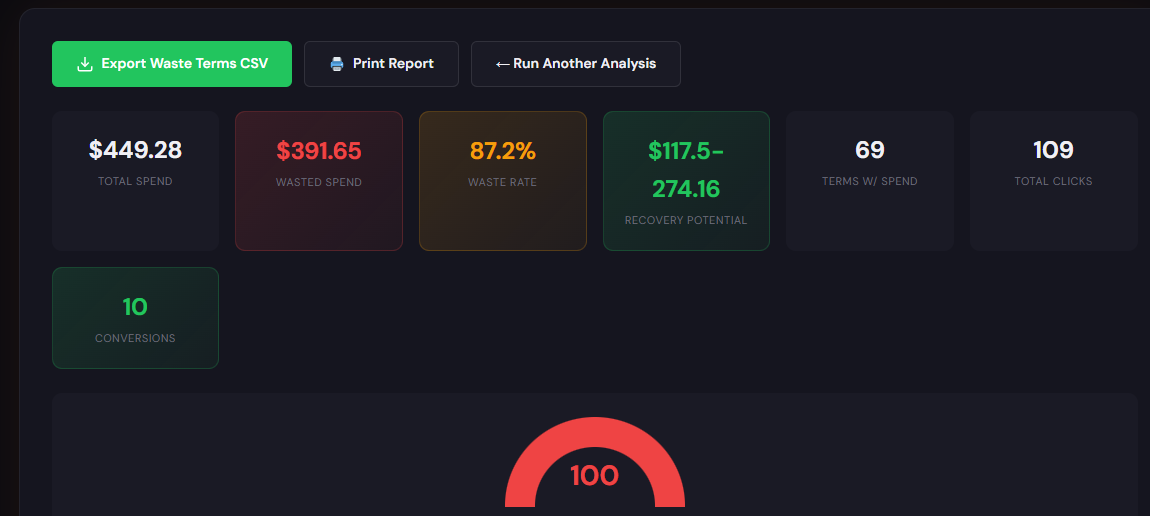
What it outputs: A prioritized leakage dashboard, top wasted keywords/search terms, campaign-level recovery steps and a short recovery plan you can execute in days.
How to use it — 3 steps
- Upload a 30–90 day Google Ads export or connect the account for a snapshot run. The tool scans spend, conversions, and PQ mismatches.
- Review the top 5 waste areas and recovery actions: negatives to add, budgets to reallocate, and landing pages to test.
- Export the recovery plan and implement the high-impact fixes (negatives, budget shifts, ad swaps) this week.
Tool: Bid Adjustment by Search Term (Search Term Analyzer)
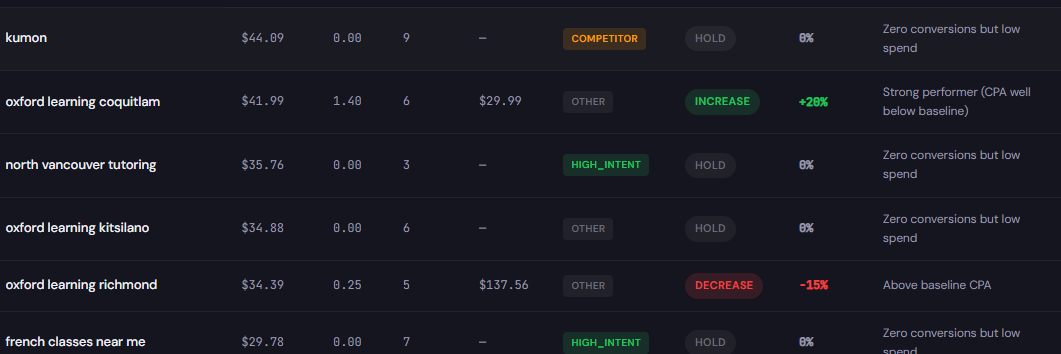
What it outputs: Search-term level table with spend, conversions, suggested bid actions (increase/decrease/pause), and tag-based grouping for fast negative creation.
How to use it — 3 steps
- Upload or paste your search-terms export (30 days recommended). The tool tags queries by intent and flags high-spend zero-conversion terms.
- Apply suggested bid adjustments for queries that are conversion-positive vs. cost-heavy, and generate a negatives list for irrelevant matches.
- Download the recommended changes as a CSV or apply them in Google Ads Editor to move fast.
Both tools are designed to cut time-to-insight. Use the Wastage Snapshot to prioritize fixes and the Search Term Analyzer to implement low-risk bid and negative changes quickly.
90-minute account triage playbook
- Minutes 0–10: Pull a 30-day top-level report (spend by campaign, conversions, CPA). Identify 3 worst-performing campaigns.
- Minutes 10–30: Run the Wastage Snapshot (or do a manual check): capture top wasted queries and top ad groups by spend without conversions.
- Minutes 30–50: Run the Search Term Analyzer on the worst campaign. Tag and export negatives; make quick negative additions for the top 10 high-spend irrelevant queries.
- Minutes 50–70: Check hour-of-day CPA for the worst campaign. Apply -20% bid multiplier on the worst 3 hours; +10% on the best 2 hours.
- Minutes 70–90: Swap landing page for the top ad group, document changes, and schedule a 7-day check-in. Export change log for handoff.
Ready to stop the leaks? Scan an account now and get a recovery plan you can act on this week. Includes search-term negatives and a bid-action CSV.
FAQ
Small, surgical fixes (negatives, ad-to-page swaps, simple dayparting) often yield measurable CPA improvements within 72 hours. Large structural changes take longer.
Smart bidding adapts; if your conversion signal is stable, short manual changes (negatives, bid multipliers) improve signal quality for automation. Monitor and rollback if performance worsens.
Start with negatives for high-cost zero-conversion queries (fastest ROI), then apply dayparting, then run landing-page swaps on top ad groups.
Yes — ExecWrite tools produce recommended actions and CSV exports for Google Ads Editor so you can review changes before applying them live.
Sources
- Google Ads Help — Smart Bidding overview (Google Ads documentation on automated bidding and how it uses signals)
- WordStream — Google Ads Benchmarks (benchmarks for CPC, CTR, conversion rates by industry)
- HubSpot — How to Reduce Wasted Ad Spend (practical ways to identify and cut wasted spend)
Leave a Reply